Helicopter Simulator IT-4429
Experimental Capabilities
The simulator supports a wide range of academic and research experiments, including:
- System modeling and dynamic analysis
- Pitch open-loop response analysis
- Pitch PID control
- Pitch and Roll PID control
- Cascade control (Pitch–Roll–Travel PID)
- 3DOF Helicopter LQR control
These experiments help students understand system behavior, stability, and controller design in a real-world context.
Key Highlights
- 3DOF motion: Pitch, Roll, and Travel control
- Real-time control system experimentation platform
- Fully compatible with MATLAB & Simulink
- High-resolution 16-bit encoder feedback
- Data acquisition up to 3.8 kHz sampling rate
- Integrated power supply and motion controller
- Slip ring mechanism for smooth signal transmission
- Ideal for automation, robotics, and aerospace studies
- Supports advanced control techniques (PID, LQR, etc.)
Technical Overview
- Max Travel Speed: 60 RPM
- Sampling Frequency: Up to 3.8 kHz
- Encoder Resolution: 16-bit
- Communication Interface: RS232 (PCI serial card included)
- Platform: PC-based control system
System Requirements
- PC with Windows 7 or later (Windows 10 recommended)
- MATLAB R2020b or later with Simulink and required toolboxes.
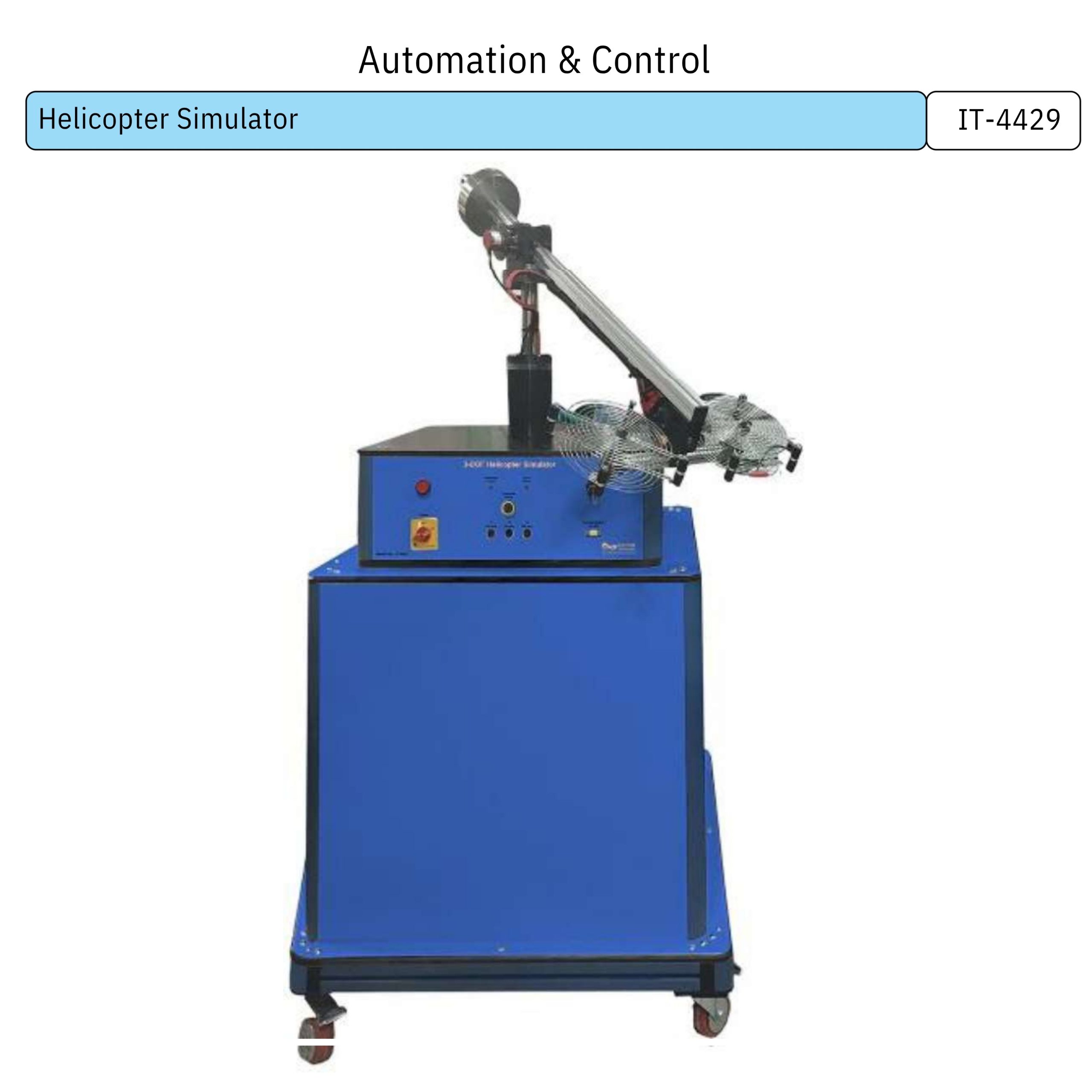
Helicopter Simulator (IT-4429) is an advanced 3 Degrees of Freedom (3DOF) educational training system designed for hands-on learning in automation, control engineering, and mechatronics. It simulates the dynamic behavior of a helicopter by allowing precise control over pitch, roll, and travel motions.
Built for academic institutions and research environments, this simulator provides a practical platform to study real-world control systems. It enables users to implement and test various control strategies such as PID, LQR, and other modern techniques in a safe and controlled environment.
The system consists of a mechanical arm mounted on a pedestal, with a helicopter body on one side and a counterweight on the other. High-precision optical encoders and motor-driven propellers ensure accurate motion control and data feedback. Integrated with MATLAB/Simulink, the simulator bridges the gap between theoretical learning and practical implementation.