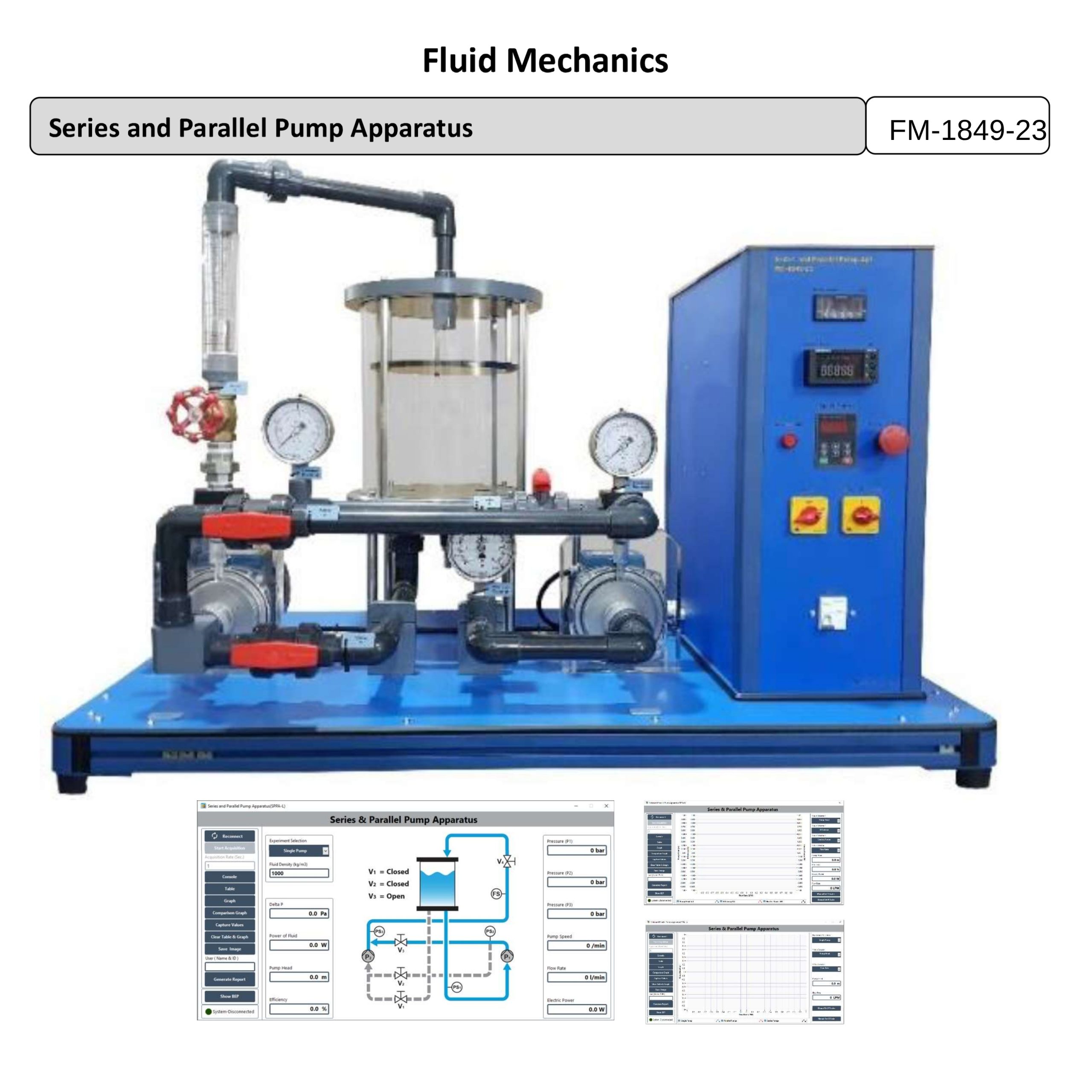
FM-1849-23 Series and Parallel Pump Apparatus
Experiments
- Study the basic operation and characteristics of centrifugal pumps
- Compare performance between single pump, series, and parallel configurations
- Plot pump characteristic curves
- Measure pump capacity and discharge
- Evaluate pump efficiency
- Determine total head and pump output
- Analyze system performance under different operating conditions
- Generate curves for:
- Head vs. discharge
- Efficiency vs. discharge
- Output power vs. discharge
Specifications
Pumps
- Two horizontal single-stage centrifugal pumps (P1 and P2)
- Maximum flow rate: up to 100 L/min
- Speed range: 0–3000 rpm (each pump)
- Parallel operation with variable speed (3-phase control)
- Maximum head (single pump): 10–12 m
Selector System
- Allows operation in:
- Single pump mode
- Series configuration
- Parallel configuration
Circulation Tank
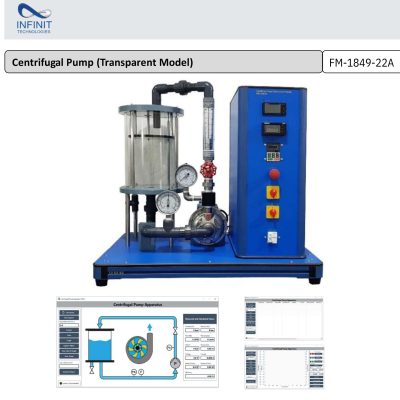
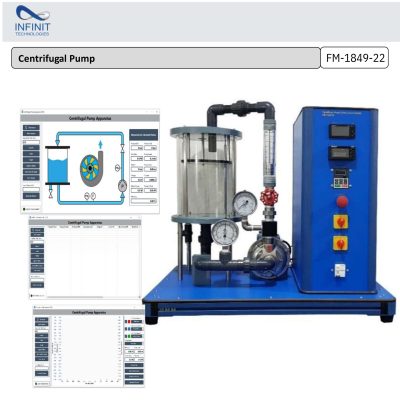
- Transparent tank for visual observation
- Supplies water to both pumps in a closed-loop system
Instrumentation
- Digital/analog indicators for:
- Flow rate
- Pump head
- Speed
- Power
- Readings displayed directly in engineering units
Process Piping
- Industrial-grade PVC piping
- Corrosion-resistant, non-ferrous valves
- Mounted on a stainless steel base frame
Measurement System
- Flow, pressure, and speed sensors
- Three manometers (inlet, intermediate, outlet)
Pressure Gauges
- 0 to 2.5 bar (2 units)
- -1 to 1 bar (1 unit)
Requirements
- Electrical supply: 220/380 VAC, 3-phase, 50/60 Hz
- Water supply: standard laboratory connection
Optional Software (FM-1849-23SW)
The optional data acquisition software is developed in a LabVIEW-based environment and provides tools for real-time measurement, data logging, and analysis. It enables users to visualize results through tables and graphs and export complete experimental data in CSV format for reporting and further study.
Scope of Delivery
- 1 × Experimental module
- 1 × Instruction manual
FM-1849-23 Series and Parallel Pump Apparatus
Pumps play a vital role across many engineering fields, including chemical processing, civil infrastructure, and environmental systems. They are widely used for applications such as fluid transfer to reactors, distillation units, and stormwater management systems. A clear understanding of pump operation and performance is therefore essential for engineering education.
The FM-1849-23 Series and Parallel Pump Apparatus is an educational training system designed to demonstrate the operating principles and performance characteristics of centrifugal pumps under different configurations. The system supports single pump operation as well as dual pump operation in both series and parallel arrangements, enabling comprehensive experimental analysis.
Centrifugal pumps are commonly used due to their quiet operation, compact design, low maintenance requirements, and ability to deliver smooth, continuous flow. This apparatus utilizes these advantages to help students investigate pump behavior in a controlled, closed-loop system.
The equipment allows users to study the relationship between flow rate and pressure head for a single pump and for two identical pumps operating together. When pumps are connected in series, the total head increases while the flow rate remains nearly constant. In contrast, when pumps operate in parallel, the flow rate increases while the head remains approximately the same as that of a single pump.
In addition to performance characteristics, the system enables analysis of pump efficiency. Energy conversion within the system occurs in two stages: electrical energy is first converted into mechanical energy to drive the pump shaft and impeller, and then into fluid energy in the form of pressure and velocity. The overall efficiency is determined by combining mechanical and hydraulic efficiencies.