FM-1849-28D Mini Wind Tunnel – Educational Aerodynamics System
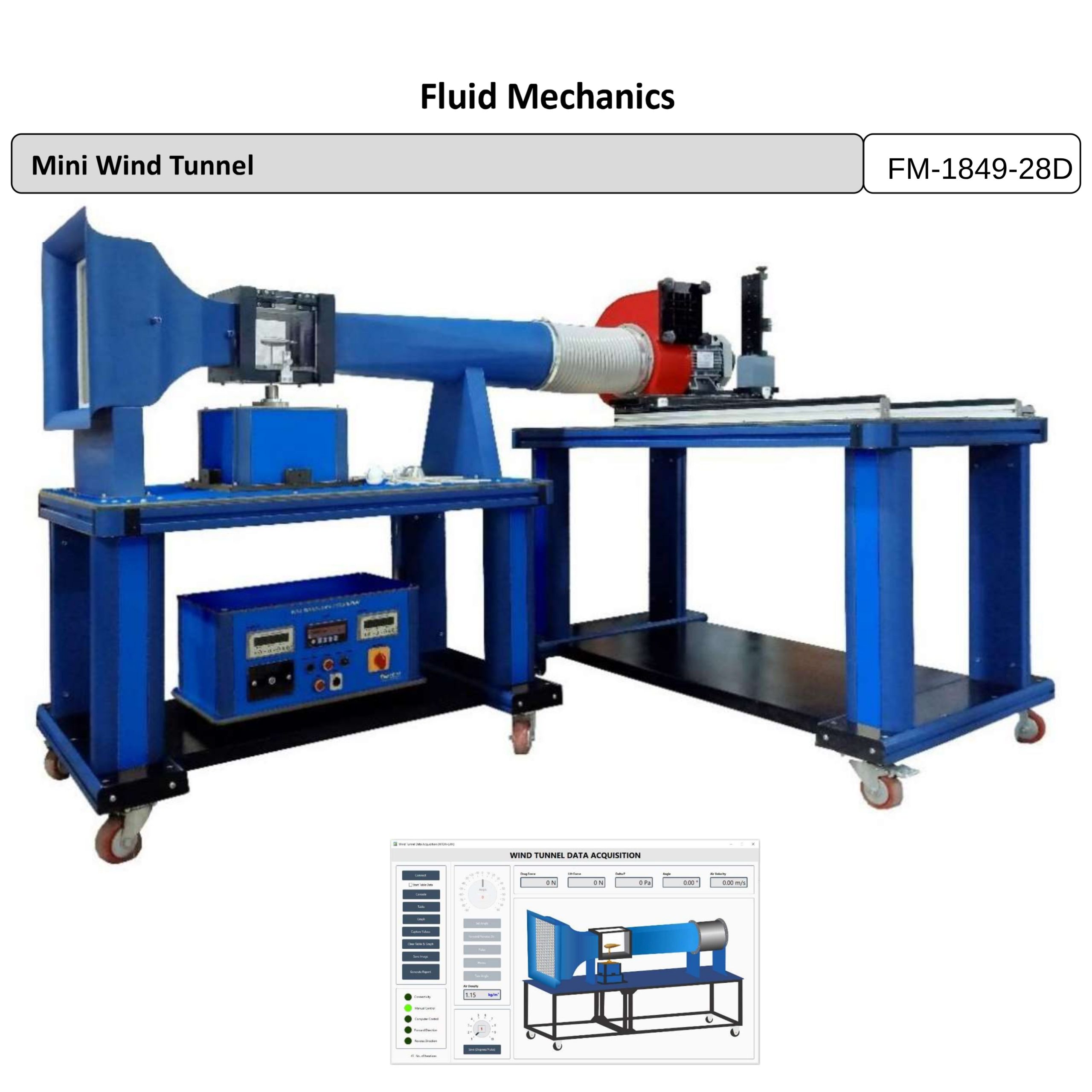
The FM-1849-28D Mini Wind Tunnel is a compact and efficient laboratory solution designed for practical learning in aerodynamics and fluid mechanics. It allows users to investigate airflow characteristics and evaluate the forces acting on models placed inside a controlled air stream.
This system is based on an open-circuit “Eiffel” type design. Air is drawn from the surroundings, accelerated through a specially shaped inlet and nozzle, and delivered into a transparent test section where experiments are conducted. A built-in flow straightener ensures smooth, low-turbulence airflow, while the diffuser gradually reduces air velocity before discharge.
The unit can generate air velocities up to 20 m/s using an energy-efficient variable-speed fan. Lift and drag forces are measured using a precise two-component force sensor with digital output. Air velocity can be observed through an inclined manometer or optional digital instrumentation.
For enhanced analysis, an optional Data Acquisition (DAQ) system allows real-time monitoring and recording of parameters such as pressure, velocity, angle, and force directly on a computer.