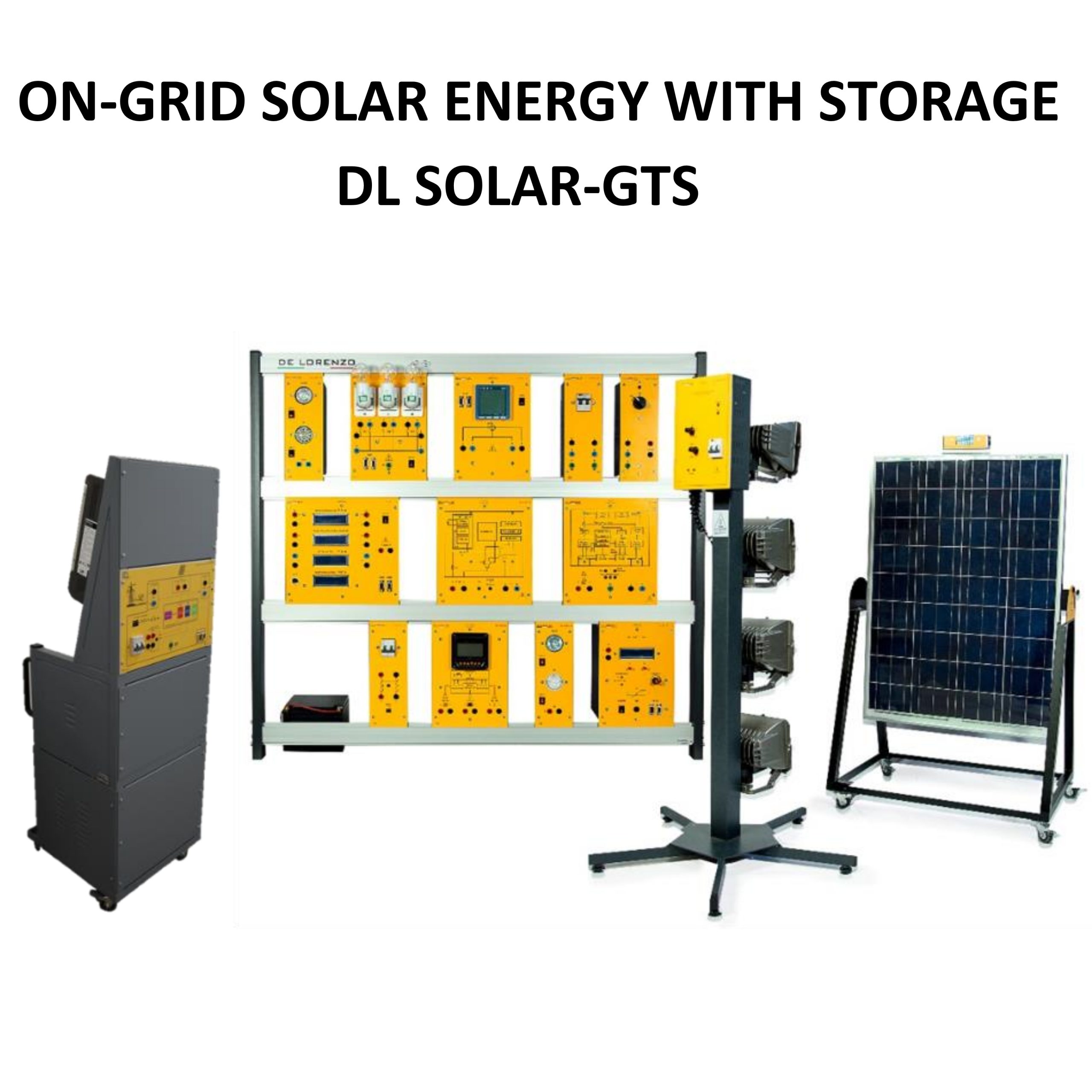
On-Grid Solar Energy with Storage DL SOLAR-GTS
Training Objectives and Educational Experiments
Solar Panel Characterization
The trainer enables detailed analysis and testing of photovoltaic panel performance through practical experiments such as:
- Measuring solar radiation intensity
- Studying the effects of solar panel inclination and azimuth
- Investigating shadow formation effects on photovoltaic performance
- Recording solar panel voltage versus irradiation characteristics
- Recording solar panel current versus irradiation characteristics
- Calculating the internal resistance of photovoltaic modules
- Obtaining current-voltage (I-V) curves
- Obtaining power-voltage (P-V) curves
- Measuring photovoltaic voltage and current under overload conditions
- Evaluating photovoltaic efficiency under varying operating conditions
These experiments provide students with deep understanding of photovoltaic energy conversion principles and real operating behavior of solar panels.
On-Grid Solar Energy System Experiments
The DL SOLAR-GTS allows users to study the operation of grid-connected solar systems through advanced practical investigations including:
- Measuring electricity delivered to the utility grid
- Monitoring electricity generated by photovoltaic panels
- Studying power exchange between the PV system and the mains grid
- Measuring AC load consumption
- Determining the efficiency of grid-connected inverters
- Investigating system response during mains power failure
- Evaluating energy flow between solar source, utility supply, and loads
- Understanding synchronization between solar inverter and electrical grid
These experiments provide practical experience with modern smart-grid and renewable energy technologies used in industrial applications worldwide.
Solar Energy Storage System Study
The integrated storage section allows users to study battery-supported solar systems and energy management techniques.
Practical studies include:
- Measuring generated photovoltaic power and battery charging process
- Operating AC loads using solar energy and battery storage
- Studying hybrid energy operation between solar panels and utility supply
- Investigating inverter charger operation modes
- Battery charging priority analysis
- Solar priority and utility priority charging modes
- Combined solar and utility charging operation
- Battery backup and energy management strategies
This section is extremely useful for understanding modern hybrid solar systems and energy storage applications.
Technical Specifications
Photovoltaic Module
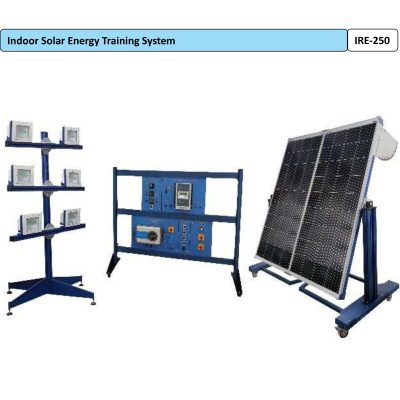
- Inclinable photovoltaic panel
- Approximate output power: 90W
- Rated voltage: 12V
- Integrated solar irradiation measurement cell
- Temperature sensor included
Sun Simulation Module
The trainer includes a professional indoor sun simulator consisting of halogen lamps that provide controlled illumination to the photovoltaic panel. This allows laboratory experiments under repeatable and stable irradiation conditions.
Multifunction Measurement Module
Integrated measuring instruments include:
- Solar irradiation measurement up to 1000 W/m²
- Solar panel temperature measurement up to 400°C
- Two DC power meters:
- 65Vdc
- 20Adc
- 1000W
- One AC power meter:
- 512Vac
- 20Aac
- 1000W
These instruments provide accurate monitoring of system electrical parameters during experiments.
Load Management Module
The system incorporates a load management module with three independent single-phase outputs for dynamic analysis of different load conditions and load types.
Active DC Load
The trainer includes an active DC load configurable as:
- Constant resistance mode
- Constant current mode
This enables advanced renewable energy laboratory testing and load simulation.
Power Supply and Rectifier Section
- Single-phase transformer
- Full-wave rectifier
- Capacitive filter
- Designed for powering DC loads from AC single-phase supply
Grid-Tie Inverter
- Grid-tie inverter operating at mains voltage
- Input voltage: 12V
- Output power: 300W
The inverter demonstrates practical grid synchronization and power injection techniques used in modern photovoltaic installations.
Three-Phase Power Analyzer
Advanced electrical parameter measurement including:
- Voltage
- Current
- Frequency
- Active power
- Reactive power
- Apparent power
This allows detailed energy analysis and power quality evaluation.
Inverter Charger Module
The inverter charger module is designed for advanced energy storage management and hybrid solar operation.
Features include:
- Solar and utility charging integration
- AC output support
- Four charging modes:
- Solar Priority
- Utility Priority
- Solar and Utility
- Solar only
- Two output modes:
- Battery mode
- Utility mode
- MPPT (Maximum Power Point Tracking) technology
- Overcurrent protection
- Reverse polarity protection
The MPPT functionality maximizes solar energy harvesting efficiency.
Human Machine Interface (HMI)
The trainer is equipped with an industrial-grade 7-inch TFT Human Machine Interface designed for renewable energy laboratories.
Features include:
- Real-time monitoring
- System parameter visualization
- Data acquisition
- Communication with instruments and drives
- Industrial communication support
- User-friendly interface for educational experiments
Communication and Software
The DL SOLAR-GTS includes advanced communication and control capability through:
- RS485 serial communication
- Modbus RTU protocol
- Preloaded educational software on HMI
- Real-time data acquisition
- Data processing and monitoring
The communication system allows students to understand industrial automation and smart energy monitoring technologies.
Safety Features
The trainer is designed with industrial safety standards and includes:
- Differential magneto-thermal protection switch
- Safe 4mm terminal connections
- Overcurrent protection
- Reverse polarity protection
- Secure mains connection
On-Grid Solar Energy with Storage Trainer (DL SOLAR-GTS)
The trainer provides a highly interactive learning environment where users can perform a wide range of experiments related to photovoltaic systems, solar irradiation measurement, solar panel characteristics, grid-connected operation, and battery storage management. The system is specially developed for universities, technical institutes, engineering laboratories, vocational training centers, and renewable energy research facilities.
One of the major advantages of the DL SOLAR-GTS system is its ability to simulate real industrial solar energy applications inside the laboratory. The complete unit is supplied with a sun simulation module using halogen lamps, allowing indoor operation independent of weather conditions. This makes the trainer ideal for continuous educational use throughout the year.
Comprehensive System Description
The DL SOLAR-GTS trainer is specifically engineered to demonstrate how electrical energy is generated from photovoltaic panels and integrated into the electrical grid while simultaneously managing battery storage systems. The modular structure allows users to study each stage of the renewable energy conversion process independently and collectively.
The system combines photovoltaic technology, power electronics, battery charging control, AC load management, inverter systems, and industrial communication protocols into one advanced educational platform. Students can observe how solar power is generated, conditioned, stored, and delivered to electrical loads or the utility grid.
The trainer also allows detailed performance evaluation of photovoltaic modules under varying irradiation levels, temperature changes, panel inclination angles, and shading conditions.