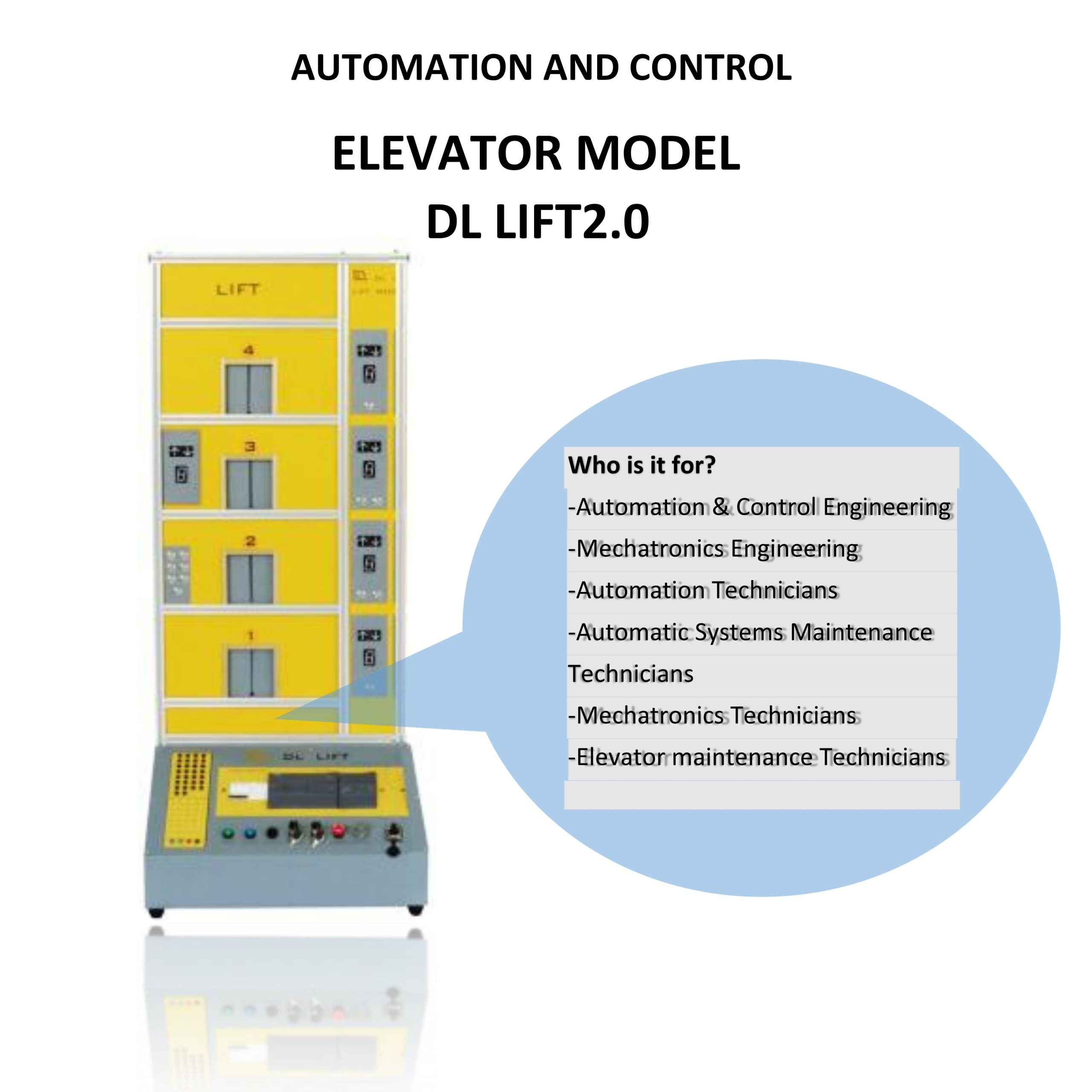
Elevator Model DL LIFT2.0

Experimental topics :
Understand basic structure and operation of the elevator model
Demonstrate manual mode operation
Demonstrate automatic mode operation
Demonstrate maintenance mode operation
Demonstrate fire mode operation
Demonstrate speed regulation function
Demonstrate remote control and data acquisition
Main features
Safer design : Safety-first electrical layout with leakage protection triggering at 30 mA and upper/lower travel limit switches.
Easier to use: Clear structure, compact form factor, and rich functions including manual, automatic, maintenance, and fire modes.
More durable: Built with solid, corrosion-resistant materials to significantly extend equipment service life.
Technical parameters
Input power: Single-phase from mains
Dimensions (L×D×H): 500 × 610 × 1200 mm
Weight: ≈ 80 kg
Ambient temperature: −10°C to +40°C
Relative humidity: < 85% at 25°C
Circuit breaker rating: 16 A / < AC 400 V
Control system — Siemens S7-1200
  1. Siemens S7-1215C DC/DC/Relay — primary controller
  2. 14 digital inputs · 10 digital outputs · 2 analog inputs · 2 analog outputs
  3. SM 1223 expansion
  4.  DI 16 × 24 Vdc
  5. DQ 16 × RELAY
  6. Network communication port
  7.  SCADA remote via web server
  8. Central laboratory PC link

System description

Independent electrical control system: Siemens PLC manages all elevator functions including call registration, floor sequencing, and direction logic.

DC drive system: DC-driven speed-controlled motor simulates real elevator running speed. A photoelectric encoder detects position and controls acceleration/deceleration profiles accurately.
Car door control system: Four automatic floor doors with mechanical interlock kits. Motors open and close the car door; an anti-pinch protection signal is included for safety.
Sensor & signal detection: Signals covered: outbound call, internal selection, levelling, position detection, door open/close position, door anti-pinch, and upper/lower limit protection.
Network & remote control: The PLC transmits elevator signals to a central computer via network communication. SCADA software enables remote control and data acquisition through a web server.
Maintenance & fire station modes: Maintenance station stops the elevator to protect technicians during servicing. Fire station mode simulates elevator behaviour during a fire emergency.
Supplied accessories:
  1. Siemens programming software× 1
  2. Spare limit switch× 2
  3. Application software× 1
  4. Network communication cable× 1
  5. Power supply cable× 1
  6. Practical manual & software set Included
Elevator Model DL LIFT 2.0
4-Floor Scale Training System with Siemens PLC Control
Dimensions: 500 × 610 × 1200 mm
Weight ≈ 80 kg
Power: Single-phase AC mains
Temp. range: −10°C to +40°C
Introduction :

The DL LIFT2.0 is a scaled, fully functional 4-floor elevator model designed to train installation, commissioning, and maintenance personnel in the elevator industry. It replicates the mechanical and electronic control systems found in real-world elevators, helping students develop practical problem-solving skills and fault-diagnosis capabilities.

Controlled by a Siemens S7-1200 PLC, the model simulates most everyday building elevators — including realistic door behaviour, floor calling, speed regulation, and remote SCADA monitoring — making it a comprehensive platform for both classroom instruction and hands-on laboratory work.

Target audience :
  • Automation & Control Engineering
  • Mechatronics Engineering
  • Automation Technicians
  • Automatic Systems Maintenance Technicians
  • Mechatronics Technicians
  • Elevator Maintenance Technicians
Related Product

Need Help?
Scroll to Top