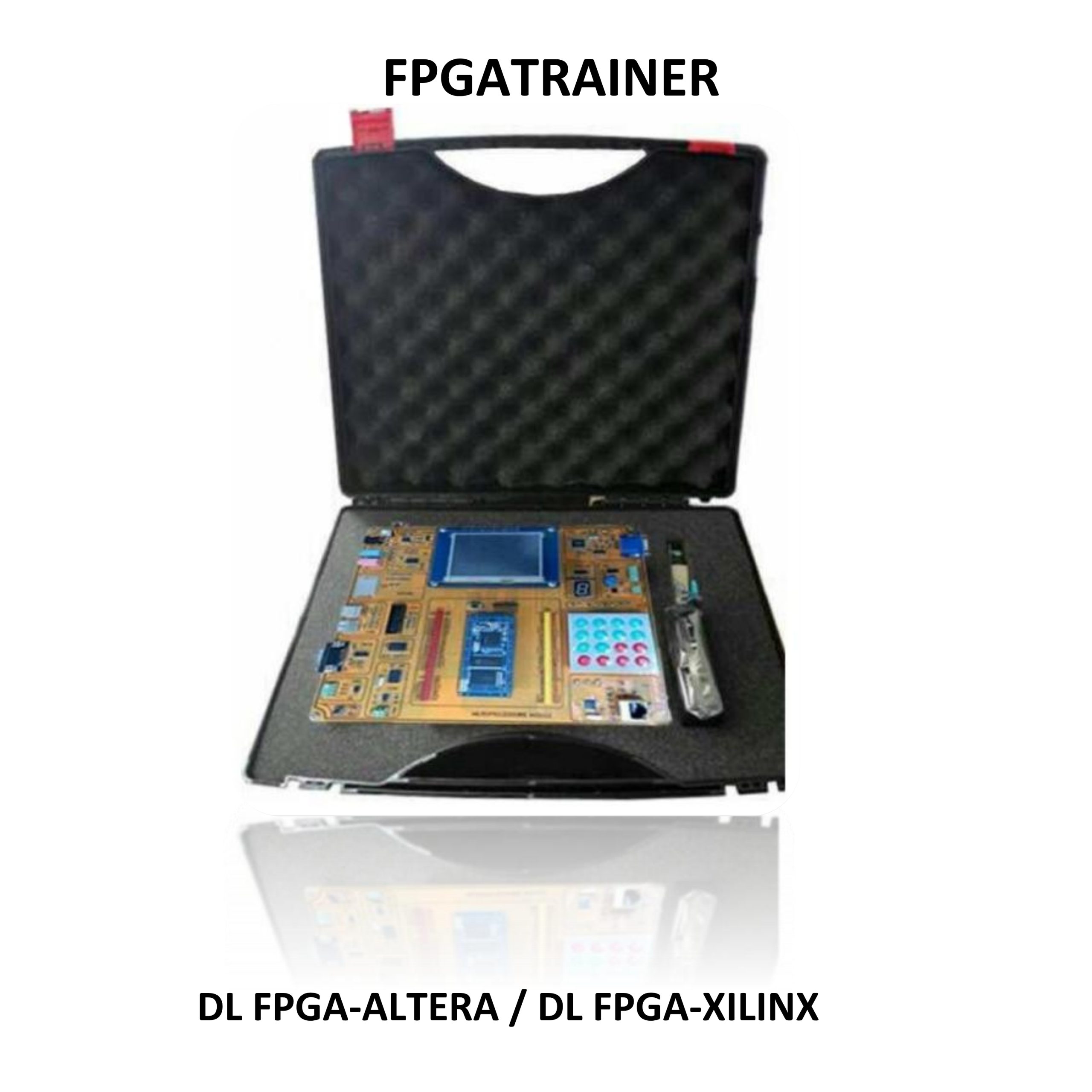
FPGA Trainer DL FPGA-ALTERA / DL FPGA-XILINX
Training Objectives & Experiments
The FPGA Trainer supports a wide range of practical experiments including:
Logic Design Experiments
- Half adder / Full adder
- 8-bit adder
- Common adder with carry
- Vector adder/subtractor
- Data comparator
- Encoder & decoder
- Eight-way selector
- Up/Down/Parallel counters
- MOORE and MEALY state machines
- Shift registers
- Pulse generator
- ROM memory design experiments
Standalone Design Experiments
- LED control
- Buzzer control
- Static and dynamic 7-segment display
- Key recognition
- EEPROM experiments
- LCD display experiments
- TFT display experiments
- VGA display
- RS232 communication
- PS/2 keyboard
- RTC (DS1302)
- Temperature sensor
- Infrared control
- AD/DA conversion
- FIFO IP Core experiments
DSP Design
- Vector multiplier
- FFT (Fast Fourier Transform) experiments
Embedded System Design (SOPC)
- Audio experiments
- Digital clock (RTC + Keyboard + TFT LCD)
- SD card interface
- USB communication
- Network communication experiments
System & Prototyping Design
- uCOS II operating system experiments
- USB-RS232 Converter ASIC design
Supplied Accessories
The trainer package includes:
- DC 5V / 2A Power Adapter
- SD Card
- USB Type A-B Cable
- USB-RS232 Converter
- Debugger & Downloader
- Connection Cables
- Technical Documentation
- Practical Manual
- Software Package
Available Versions
The DL FPGA Trainer is available in two versions:
1. DL FPGA-ALTERA
- Based on Altera (Intel) Cyclone IV FPGA, chip EP4CE10
- 32Mbit Serial Flash (M25P32)
- 256Mbit SDRAM (MT48LC16)
- JTAG configuration mode for downloading and debugging
- Supports over 32 extended user I/Os
- Software: Quartus II / SOPC Builder / NIOS II / Signal Tap II
- Compatible with Windows 10 & Windows 11 Professional (64-bit)
2. DL FPGA-XILINX
- Based on Xilinx Spartan VI FPGA, chip XC6SLX9
- 32Mbit Serial Flash (M25P32)
- 256Mbit SDRAM (MT48LC16)
- JTAG configuration mode
- More than 32 extended user I/Os
- Software: ISE / EDK / SDK / ChipScope
- Compatible with Windows 10 & Windows 11 Professional (64-bit)
Main Board Technical Features
Both versions include a feature-rich main board with:
- 1 Potentiometer (0–3.3V voltage signal)
- 8 LEDs
- 4 x 7-segment LEDs
- 1 Buzzer
- 8 Bit switches
- 4×4 Keyboard
- IIC EEPROM (24C04)
- 16-bit VGA interface
- 1602 LCD interface with display
- 240×320 TFT colorful LCD interface with display
- USB-RS232 communication interface
- PS/2 keyboard interface
- SD card interface with 4GB SD card
- DS1302 clock interface
- Temperature sensor interface with DS18B20
- Infrared receiving interface with remote control
- AD interface
- DA interface
- USB device interface
- Ethernet interface
- Audio CODEC interface
- 8 Fault simulation modules
FPGA Trainer (DL FPGA-ALTERA / DL FPGA-XILINX)
The FPGA Trainer (DL FPGA) is an advanced educational and development platform designed to provide practical training in Field Programmable Gate Array (FPGA) technology. FPGA is a programmable integrated circuit that can be configured after manufacturing to perform customized logic functions, making it highly flexible for modern digital system design. Unlike fixed-function chips, FPGA technology enables reprogrammable hardware, allowing logic gates to be reconfigured for different applications, while supporting parallel processing to execute multiple operations simultaneously for faster performance.
This training system is ideal for applications in signal processing, cryptography, secure communication, robotics, automation, AI acceleration, neural networks, and custom chip prototyping before mass production. Engineers and students can customize chip behavior using hardware description languages such as Verilog and VHDL, making the trainer suitable for both academic learning and real-world project development.
The trainer is developed as a multi-function teaching and development equipment with high configuration and quality, suitable for EDA (Electronic Design Automation) teaching, course design, graduation projects, and research laboratories. It adopts a unique double-board structure (“Main Board + Core Board”), where all I/O pins can be configured to support experiments ranging from simple digital logic circuits to advanced embedded system designs. This architecture simplifies circuit modification, shortens development cycles, reduces hardware complexity, minimizes chip quantity and system volume, and improves overall system reliability through software-based design and simulation instead of traditional hardware wiring methods.