Continuous Stirred Tank Reactor (Stand Alone) – CRE-3306
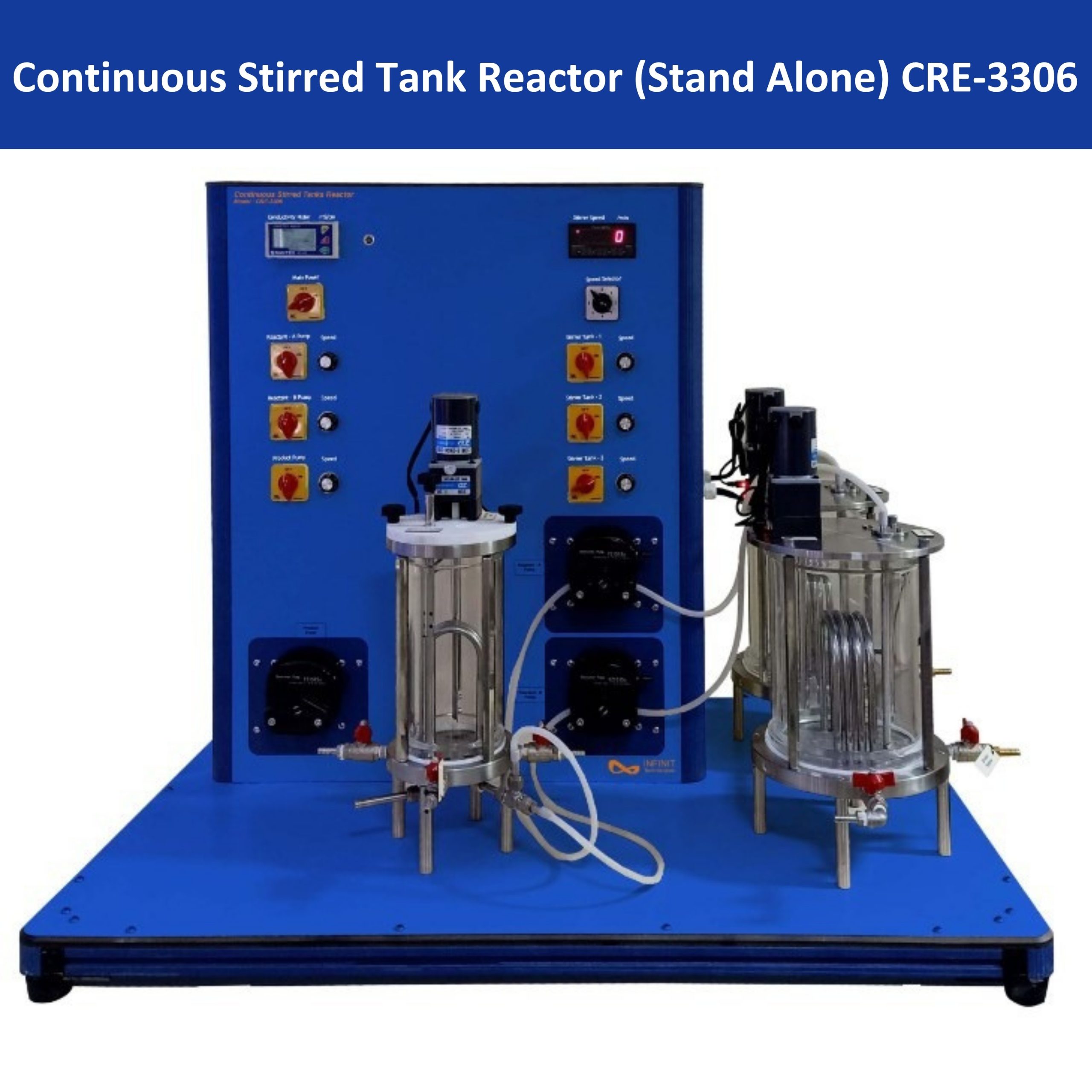
The Continuous Stirred Tank Reactor (Stand Alone) – CRE-3306 is an advanced laboratory training and research system designed for studying the principles of Chemical Reaction Engineering. It is specially developed to analyze the performance and behavior of stirred tank reactors under both continuous and batch (intermittent) operating conditions. The system provides students, researchers, and engineering laboratories with practical knowledge of reaction kinetics, conversion processes, retention time, temperature effects, and concentration variations in chemical reactions.
The equipment is widely suitable for Chemical Engineering laboratories, university research facilities, technical institutes, and industrial training centers. It enables detailed investigation of reactor operations using a safe, compact, and efficient experimental setup. The CRE-3306 allows users to perform various experiments related to the saponification reaction, while also studying how operating parameters influence reactor performance.
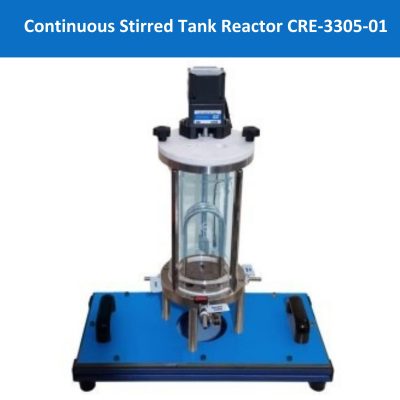
The CRE-3306 can be securely attached to the supply unit using two locking pins, allowing quick installation and easy operation. Quick-release connections are provided for fast connection between the reactor and the supply unit. Two peristaltic pumps continuously feed reactants into the reactor chamber to maintain uninterrupted reactor operation.
Inside the reactor, a motor-driven stirrer continuously mixes the reactants to ensure a homogeneous solution and improve contact between reacting substances. This efficient mixing increases reaction effectiveness and ensures uniform temperature and concentration distribution throughout the reactor. The reactants then chemically react to form the desired product.
The mixture of products and unreacted chemicals exits through an adjustable overflow system and is transferred into a collection tank. The overflow height can be modified, allowing users to change the effective reactor volume according to experimental requirements. By adjusting the flow rate of the peristaltic pumps, the retention time or residence time of reactants inside the reactor can also be varied. This feature allows detailed analysis of the relationship between residence time and chemical conversion.
The reactor is equipped with a stainless steel chambered bottom heat exchanger, enabling temperature control and heat transfer studies. This arrangement allows users to investigate the influence of temperature on reaction rate and conversion efficiency.
To monitor the reaction process accurately, the system includes a combined conductivity and temperature sensor. Conversion inside the reactor is determined through conductivity measurement. Both temperature and conductivity values are digitally displayed on the switch cabinet of the supply unit for real-time monitoring. Additionally, optional data acquisition software can record, process, and analyze experimental data for advanced research and reporting purposes.