Continuous Stirred Tank Reactor in Series (Stand Alone) – CRE-3307
Experiments of CRE-3307 Continuous Stirred Tank Reactor in Series:
- Fundamentals of Saponification Reaction
Study the basic principles, reaction mechanism, and behavior of continuous stirred tank chemical reactions. - Conversion Analysis Based on Retention Time
Investigate how reactor conversion changes with different residence or retention times in each stirred tank reactor. - Conversion Analysis Based on Temperature
Observe the effect of temperature variation on reaction rate and conversion efficiency in the reactor series. - Conversion Analysis Based on Concentration
Analyze how changes in reactant concentration influence reactor performance and product conversion. - Study of Continuous Stirred Tank Reactor Behavior
Examine mixing characteristics, flow behavior, and sequential reactor operation in continuous processing systems. - Sequential Reactor Performance Study
Compare the performance and efficiency of multiple stirred tank reactors connected in series versus a single reactor system. - Temperature Control and Heat Transfer Study
Investigate reactor temperature regulation using the integrated heating water circulation system and stainless-steel heat exchanger. - Conductivity Measurement Experiment
Monitor conductivity changes during reactions to evaluate reaction progress and concentration variation.
Continuous Stirred Tank Reactor in Series (Stand Alone) – CRE-3307
The CRE-3307 Continuous Stirred Tank Reactor in Series is an advanced chemical reaction engineering training and research system designed for studying the behavior and performance of continuous stirred tank reactors (CSTRs) connected in series. This sophisticated laboratory apparatus is specially developed for chemical engineering education, industrial training, and experimental analysis of reaction kinetics, process control, and reactor performance under various operating conditions.
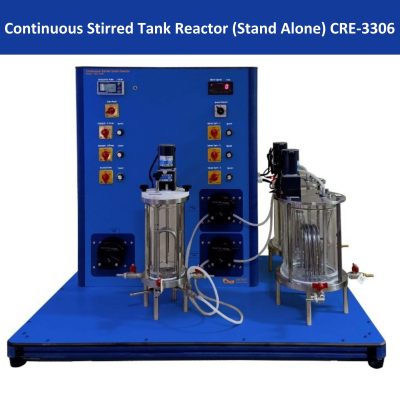
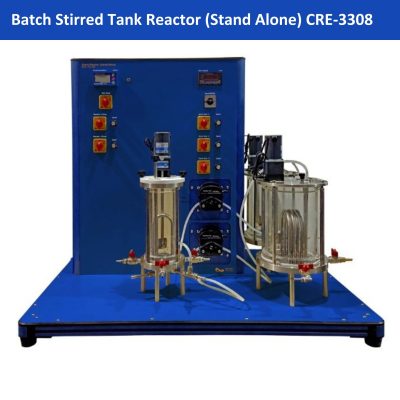
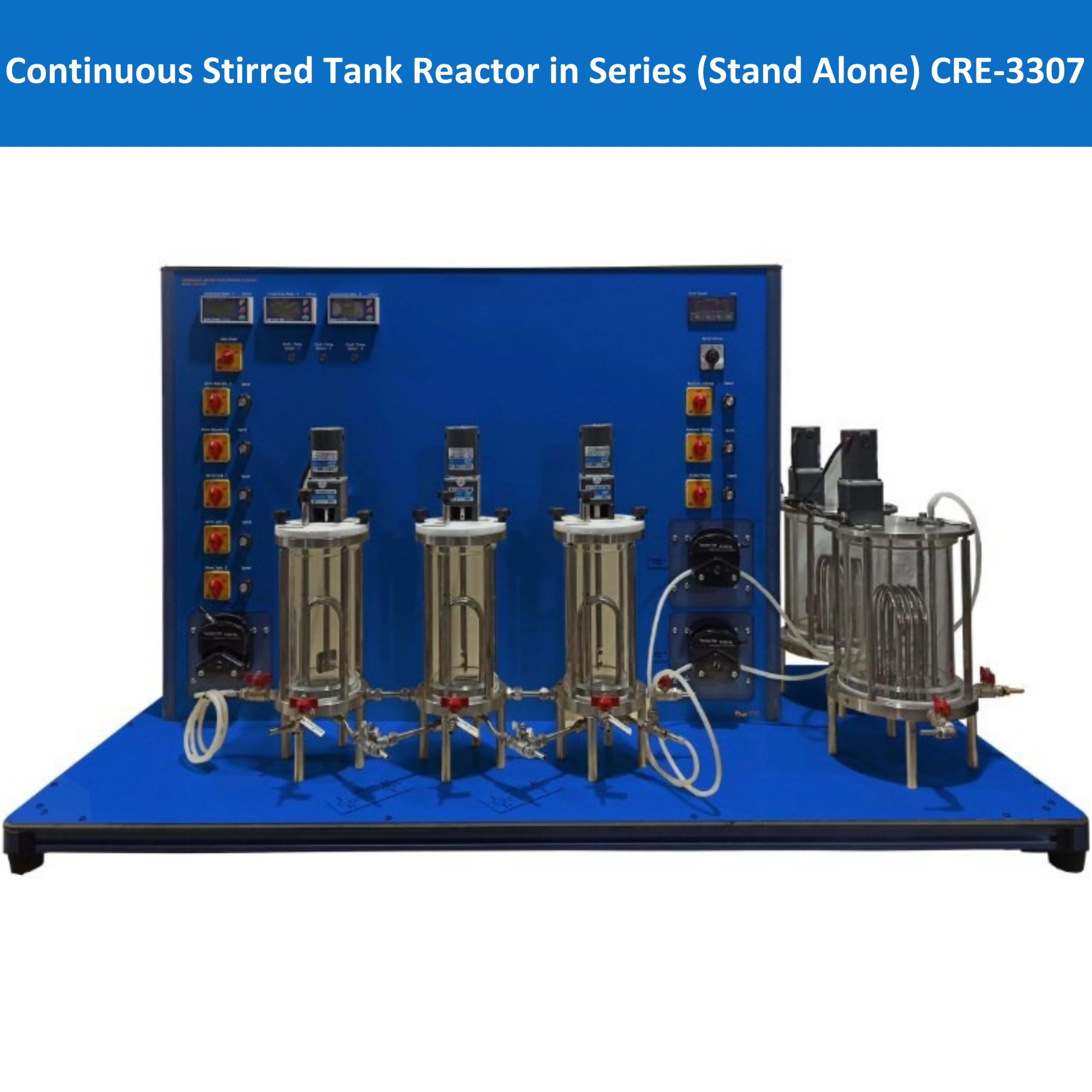
The system consists of three identical stirred tank reactors connected sequentially, allowing users to investigate how conversion efficiency improves when multiple reactors operate in series compared to a single reactor. Since each reactor can operate with different temperature and retention time conditions, the unit provides exceptional flexibility for studying variable process control and reaction optimization in continuous processing systems.
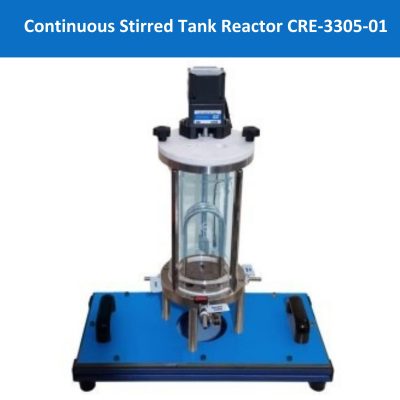
The CRE-3307 is part of a modular reactor series designed to support research and experimentation with various reactor configurations. The equipment enables detailed observation of stirred tank reactor behavior, flow characteristics, mixing performance, and sequential reaction processes. The transparent borosilicate glass construction allows students and researchers to visually monitor the reaction process during operation, making it highly effective for laboratory demonstrations and academic instruction.
The apparatus is equipped with a complete heating water circulation system along with all required connections, reactant tanks, product tanks, pumps, and instrumentation required for continuous operation. The integrated heating system uses a stainless-steel chambered bottom heat exchanger to maintain and control reactor temperature accurately throughout experiments. Quick-release connections allow the reactor setup to be connected or disconnected easily from the supply unit, ensuring convenient installation, maintenance, and operation.
For precise monitoring and control, the unit includes sensors for measuring both conductivity and temperature, with digital displays providing real-time experimental data. This enables accurate evaluation of reaction progress, concentration changes, and thermal conditions during experiments. The integrated temperature control system further enhances experimental accuracy and process stability.
The system is specifically designed for conducting experiments related to the fundamentals of saponification reactions and the study of conversion efficiency in each reactor as a function of retention time, temperature, and reactant concentration. These experiments help students understand key chemical reaction engineering concepts such as reaction kinetics, residence time distribution, conversion improvement in reactor series, and the influence of operating parameters on reactor performance.
The CRE-3307 features three glass reactors, each having an outer diameter of 110 mm, inner diameter of 100 mm, and height of 250 mm. Each reactor provides an adjustable working volume ranging from approximately 1500 mL to 1950 mL, minimizing chemical consumption while maintaining effective experimental capability. The reactors are constructed using durable Boro 3.3 glass, ensuring excellent chemical resistance and long operational life.
The stirring mechanism operates at an approximate speed of 300 rpm, providing efficient mixing and uniform reactant distribution within the reactors. The system also includes two peristaltic pumps for reactant delivery and an additional peristaltic pump for product transfer, each capable of flow rates up to approximately 500 mL/min. These pumps ensure smooth and controlled continuous flow operation throughout the experimental process.
Overall, the CRE-3307 Continuous Stirred Tank Reactor in Series is an ideal educational and research platform for universities, technical institutes, and industrial laboratories seeking comprehensive practical training in chemical reaction engineering, continuous reactor systems, and process control analysis. Its modular design, precise instrumentation, transparent reactor construction, and flexible operating conditions make it a highly effective solution for advanced laboratory experimentation and professional training applications.