Diffusion in Liquids and Gases CRE-3301
Educational Objectives
- Study the fundamentals of diffusion and mass transfer
- Demonstrate and verify Fick’s Law
- Understand concentration-driven molecular transport
- Derive equations for calculating diffusion coefficients
- Determine diffusion coefficients in liquids
- Determine diffusion coefficients in gases
- Analyze one-dimensional diffusion processes
- Investigate the influence of temperature and concentration gradients on diffusion
Main Features
- Complete investigation system for diffusion in liquids and gases
- Transparent diffusion tank for easy visualization
- U-tube with multiple capillaries for liquid diffusion experiments
- Conductivity measurement system for concentration analysis
- Heated water bath for gaseous diffusion experiments
- Controlled evaporation system using volatile solvents
- Fan-assisted vapor removal for stable diffusion conditions
- Integrated magnetic stirrer for uniform concentration distribution
- Precision microscope for accurate liquid level measurement
- Separate control and display unit for convenient operation
- Temperature controller with heater and sensor
- Compact and laboratory-friendly design
Technical Specifications
Tank and Stirrer
- Tank capacity: approximately 6000 mL
- Integrated magnetic stirrer
- Stirring speed: 0 – 500 rpm
- Magnetic stirrer bar included
Heater
- Heater power: approximately 300 W
- Controlled heating system with temperature sensor
Liquid Diffusion Unit
- U-shaped diffusion tube
- Number of capillaries: 250 – 300
- Capillary diameter: 1 mm
- Capillary length: 5 – 8 mm
Measurement Ranges
- Temperature range: 100 – 400°C
- Conductivity range: 0 – 200 mS/cm
Conductivity Meter
- Measuring range: 0 – 2000 µS/cm
- Graduation: 1 µS/cm
Gaseous Diffusion Unit
- Diffusion tube diameter: 4 mm
- Diffusion tube length: 100 mm
- Fan flow rate: 120 – 320 L/h
Microscope
- Scale division: 0.1 mm
- Height-adjustable design for accurate monitoring
Diffusion in Liquids and Gases CRE-3301
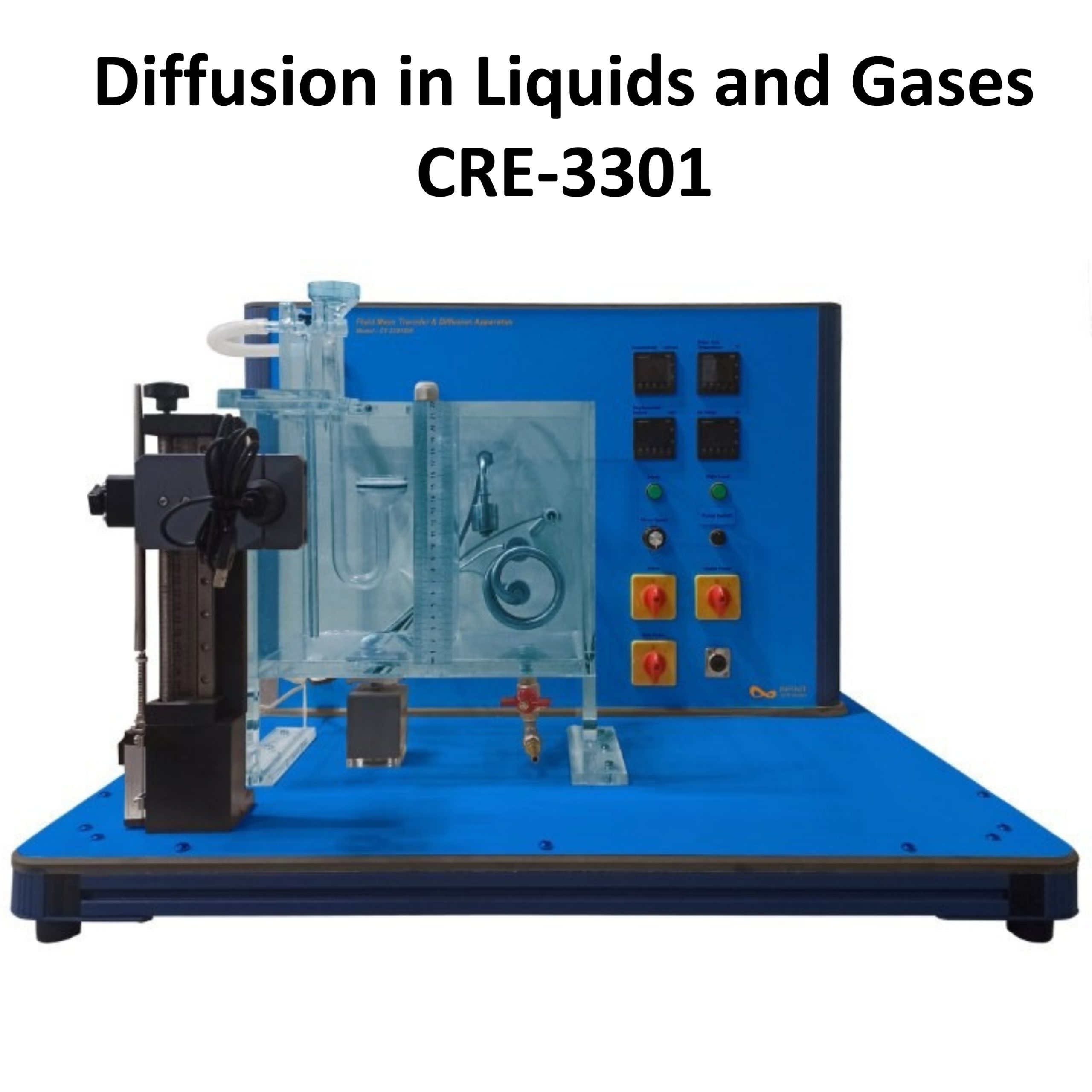
The Diffusion in Liquids and Gases Trainer (CRE-3301) is an advanced experimental unit designed for the study of mass transfer and diffusion phenomena in both liquids and gases. This educational system provides a practical understanding of molecular diffusion, concentration gradients, and transport mechanisms that are fundamental in chemical reaction engineering, chemical processing, and industrial applications. The trainer enables students and researchers to investigate diffusion behavior under controlled laboratory conditions while demonstrating the principles of Fick’s Law of Diffusion.
The system is specially developed for engineering laboratories, technical institutes, universities, and research centers to provide hands-on experience with diffusion processes occurring in liquid and gaseous media. It combines two separate experimental arrangements in a single integrated setup, allowing comprehensive analysis of diffusion coefficients and mass transport phenomena.
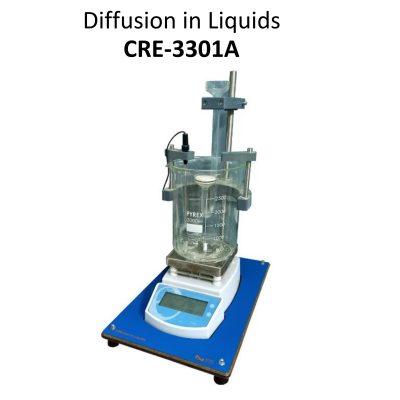
In the liquid diffusion experiment, a concentrated salt solution is placed inside a specially designed U-shaped diffusion tube equipped with numerous vertical capillaries. The U-tube is immersed in a transparent tank filled with demineralized water. Due to the concentration difference between the salt solution and the surrounding water, salt ions diffuse through the capillaries into the water. The capillary arrangement ensures one-dimensional diffusion, enabling accurate observation and analysis of diffusion behavior. A built-in magnetic stirrer continuously mixes the water in the tank to eliminate local concentration variations and maintain uniform conditions throughout the experiment. The increase in salt concentration within the tank is measured using an integrated conductivity meter, providing accurate and reliable experimental data.
For gaseous diffusion studies, the trainer uses a highly volatile solvent contained within a vertical diffusion tube immersed in a temperature-controlled hot water bath. Thermal energy supplied by the heater causes the solvent to evaporate. At the top of the diffusion tube, a controlled airflow generated by a fan removes the solvent vapor continuously, maintaining a stable concentration gradient between the liquid surface and the flowing air. This setup allows detailed investigation of gaseous mass transport and solvent diffusion. The solvent level reduction over time is measured using a height-adjustable precision microscope with fine scale divisions, enabling accurate determination of diffusion rates and coefficients.
The CRE-3301 trainer offers a complete educational platform for understanding diffusion mechanisms in chemical engineering processes. The transparent construction of the apparatus allows clear observation of experimental phenomena, making the learning experience highly visual and interactive. The separate display and control unit includes temperature control functions and fan operation management, ensuring precise adjustment of experimental parameters.