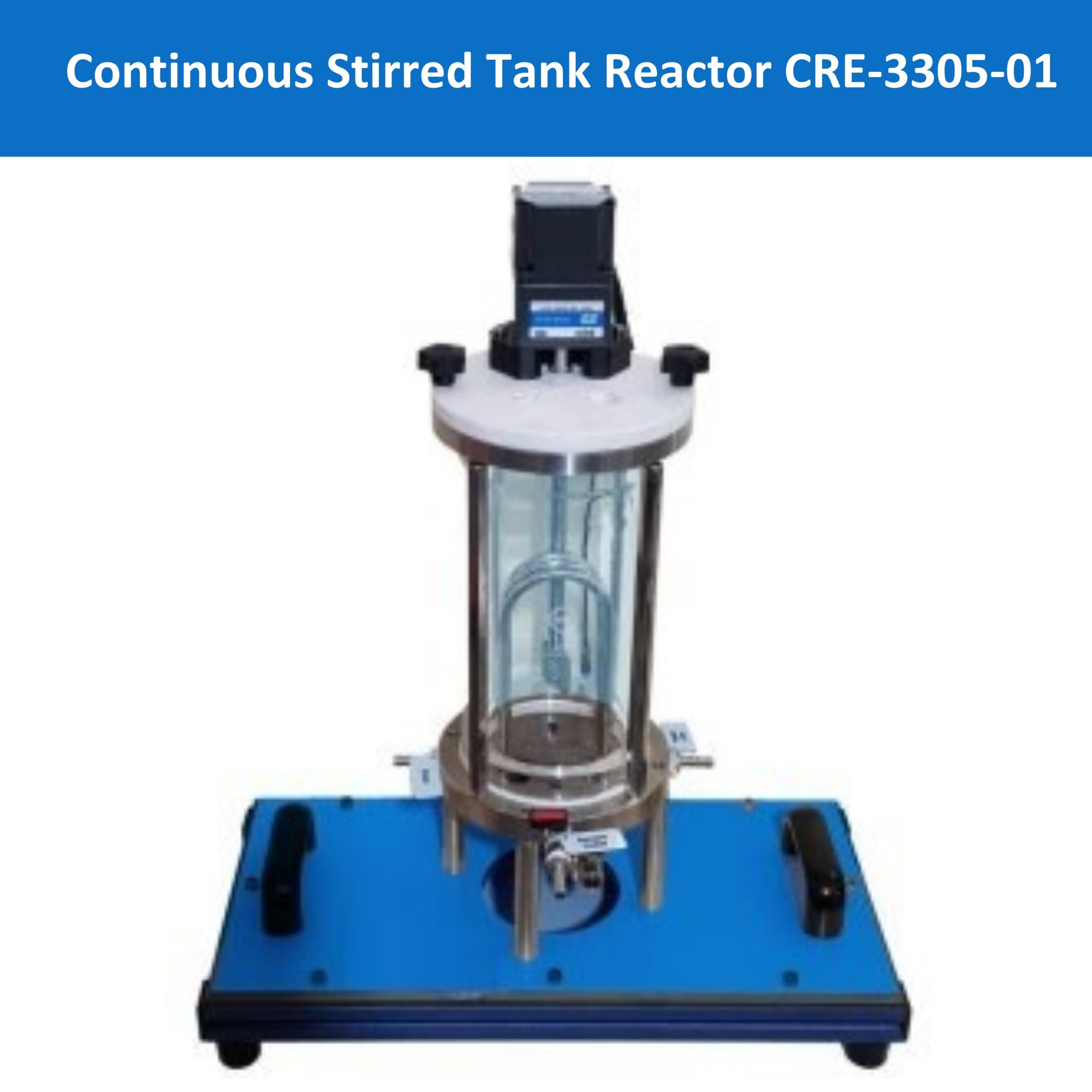
Continuous Stirred Tank Reactor – CRE-3305-01
Experiments Included
The CRE-3305-01 supports a wide range of practical experiments related to chemical reaction engineering, including:
- Fundamentals of saponification reaction
- Study of conversion based on retention time
- Effect of temperature on reaction conversion
- Effect of concentration on reaction behavior and performance
Main Features
- Continuous stirred tank reactor designed for connection with service unit CRE-3305
- Transparent borosilicate glass reactor tank for clear process observation
- Height-adjustable overflow for variable reactor volume
- Efficient stirrer system for homogeneous mixing
- Integrated conductivity and temperature measurement system
- Digital indication of process parameters
- Stainless-steel chambered bottom functioning as heat exchanger
- Easy installation using quick-release connections and locking pins
Technical Specifications
Stirred Tank Reactor
- Reactor type: DN 100
- Height: 250 mm
- Material: Borosilicate Glass 3.3
- Reactor capacity: Approximately 1950 mL
Stirrer
- Speed: 300 min⁻¹
- Variable speed drive
- Brushless geared motor
Required Equipment
- Service Unit for Chemical Reactors CRE-3305
Continuous Stirred Tank Reactor – CRE-3305-01
The Continuous Stirred Tank Reactor (CSTR) CRE-3305-01 is an advanced laboratory training and research system designed for studying the principles of chemical reaction engineering, particularly the behavior and operation of stirred tank reactors under both continuous and batch operating conditions. It is specially developed for educational institutions, engineering laboratories, chemical process training centers, and research applications where practical understanding of reactor dynamics and process parameters is essential.
This reactor system allows students, researchers, and laboratory users to investigate how different operating conditions influence chemical conversion and reactor performance. The unit is ideal for demonstrating industrial chemical processing techniques and understanding the fundamentals of reaction kinetics, residence time distribution, heat transfer, and mixing processes in continuous reactor systems.
The operation of stirred tank reactors can be performed either continuously or intermittently. Batch or discontinuous operation is generally used when reaction rates are slow or when only small quantities of products are required. In contrast, continuous stirred tank reactors are widely used in industry because they provide stable, reliable, and continuous production of products with consistent quality. The CRE-3305-01 enables comprehensive study of both these reactor modes in a controlled laboratory environment.
The reactor is designed to operate together with the Service Unit for Chemical Reactors CRE-3305, which supplies all essential utilities required for the experiment. The service unit includes reactant tanks, pumps, a product tank, heating water circuit, and all necessary process connections. The reactor module can be quickly mounted onto the service unit using two securing pins and connected through quick-release fittings, ensuring simple installation and easy operation during laboratory sessions.
Inside the reactor, two pumps continuously feed reactants into the vessel. A high-efficiency stirrer ensures complete mixing of reactants, creating a homogeneous reaction environment and improving contact time between reacting substances. This continuous mixing process helps achieve stable reaction conditions and uniform product quality. The reaction products, along with any remaining unconverted reactants, exit the reactor through an overflow system and are transferred into a collection tank located in the service unit.
One of the major advantages of the CRE-3305-01 is its adjustable overflow arrangement. The overflow height can be varied to change the effective reactor volume, allowing users to investigate how reactor volume influences reaction performance and conversion efficiency. Additionally, the residence or retention time of reactants inside the reactor can be controlled by adjusting the pump speeds on the service unit. This feature enables detailed study of the relationship between flow rate and chemical conversion.
The reactor is also equipped with a chambered stainless-steel bottom that functions as an integrated heat exchanger. This allows precise temperature control and investigation of temperature effects on chemical reactions. The heating system makes it possible to perform experiments under different thermal conditions, helping students understand the importance of heat transfer and temperature control in industrial chemical reactors.
For process monitoring and analysis, the system uses conductivity measurement to determine the degree of conversion during reactions. The equipment includes a conductivity and temperature combination sensor connected to the service unit, where both parameters are digitally displayed for accurate observation and data analysis. This enables real-time monitoring of process conditions and enhances experimental understanding.