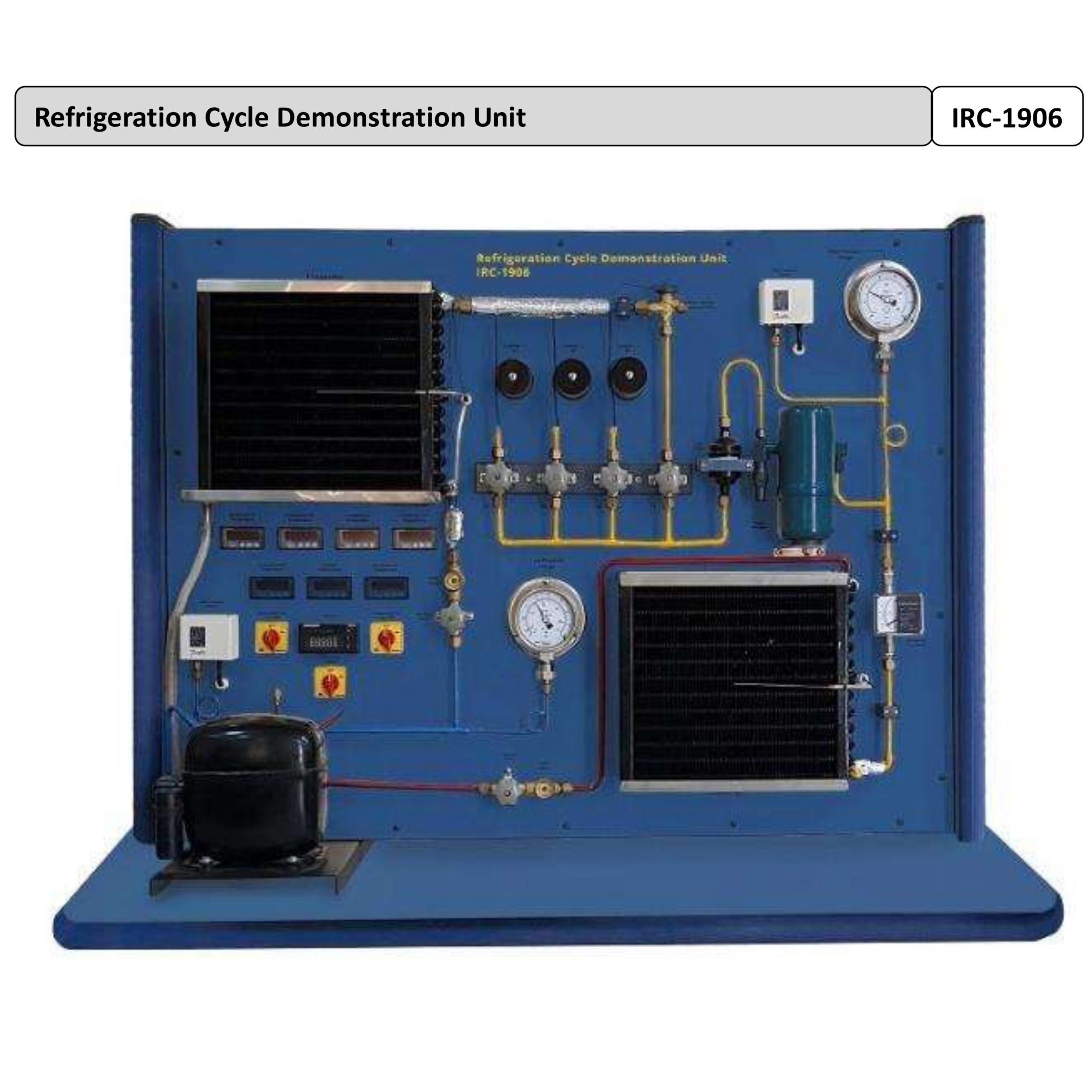
Refrigeration Cycle Demonstration Unit IRC-1906
Experiments and Learning Applications
This trainer enables users to perform multiple practical experiments, including:
- Study of refrigerant underfilling and overfilling conditions
- Thermodynamic cycle analysis using the P-h diagram
- Investigation of refrigeration circuit component functions and operational behavior
- Analysis of expansion valve operation and capillary tube characteristics
- Calculation of refrigeration capacity from P-h diagram and measured values
- Performance comparison using actual measured system data
- Calculation of coefficient of performance (COP)
- Compressor efficiency analysis
System Specifications
The Refrigeration Cycle Demonstration Unit is designed for detailed investigation of refrigeration systems with multiple expansion elements and industrial instrumentation.
Main Features:
- Refrigeration circuit with hermetic compressor, condenser, evaporator, and expansion device
- Finned tube heat exchangers for condenser and evaporator
- Sight glass for observing refrigerant phase transitions
- Expansion valve and multiple capillary tubes with different lengths
- Refrigerant receiver for charging/discharging studies
- Pressure and temperature monitoring sensors
- Compressor with dual pressure switches
- Optional USB data acquisition software for PC connectivity
- Uses R134a refrigerant (CFC-free)
Technical Data
Compressor
- Power Consumption: 250W at 7.2o/32oC
- Refrigeration Capacity: 400W at 7.2/32oC
Condenser
- Fan cooled continuous tubing with external finned design
Delivery Side (High Pressure Gauge)
- Pressure Range: -1 to 25 bar
Temperature Sensors
- Range: -40°C to 400°C
- Type-K sensors
- Total Sensors: 7
Educational Benefits
The IRC-1906 trainer is ideal for:
- Universities
- Technical institutes
- Polytechnic laboratories
- HVAC training centers
- Engineering research labs
It helps learners bridge theoretical refrigeration concepts with real industrial practice through hands-on experimentation, system diagnostics, performance measurement, and thermodynamic analysis.
Refrigeration Cycle Demonstration Unit – IRC-1906
is an advanced educational training system designed to provide practical understanding of refrigeration and air conditioning principles. This trainer allows students, researchers, and technical professionals to study the complete refrigeration cycle through a real working system equipped with industrial-standard components and measurement instruments.
The unit consists of a hermetic compressor, condenser, evaporator, and expansion elements, enabling users to observe and analyze the refrigeration process in detail. The system uses finned tube heat exchangers as both condenser and evaporator for effective heat transfer demonstration and phase transition observation of refrigerants.
To compare different expansion devices, the trainer includes three capillary tubes of various lengths along with a thermostatic expansion valve, allowing users to study the operational differences and effects of each expansion method on system performance.
A built-in refrigerant receiver is included with the trainer, allowing refrigerant to be added or removed from the circuit. This feature makes it possible to study the effects of underfilling and overfilling refrigerant within the system, helping learners understand how refrigerant charge impacts system efficiency and operational stability.
The trainer is equipped with a flow meter for measuring refrigerant flow rate. Integrated sensors continuously monitor important parameters such as:
- Temperature
- Pressure
- Electrical usage of compressor
Measured values are displayed digitally for easy observation and analysis. Additionally, the system supports data capture software (optional), enabling measured data to be transferred directly to a PC via USB for further analysis and documentation.
The software also provides P-h (Pressure-Enthalpy) diagram visualization, allowing users to dynamically observe refrigeration parameter changes within the cycle.