Refrigeration and Air Conditioning –
Automotive Air Conditioning Trainer IRC-1913
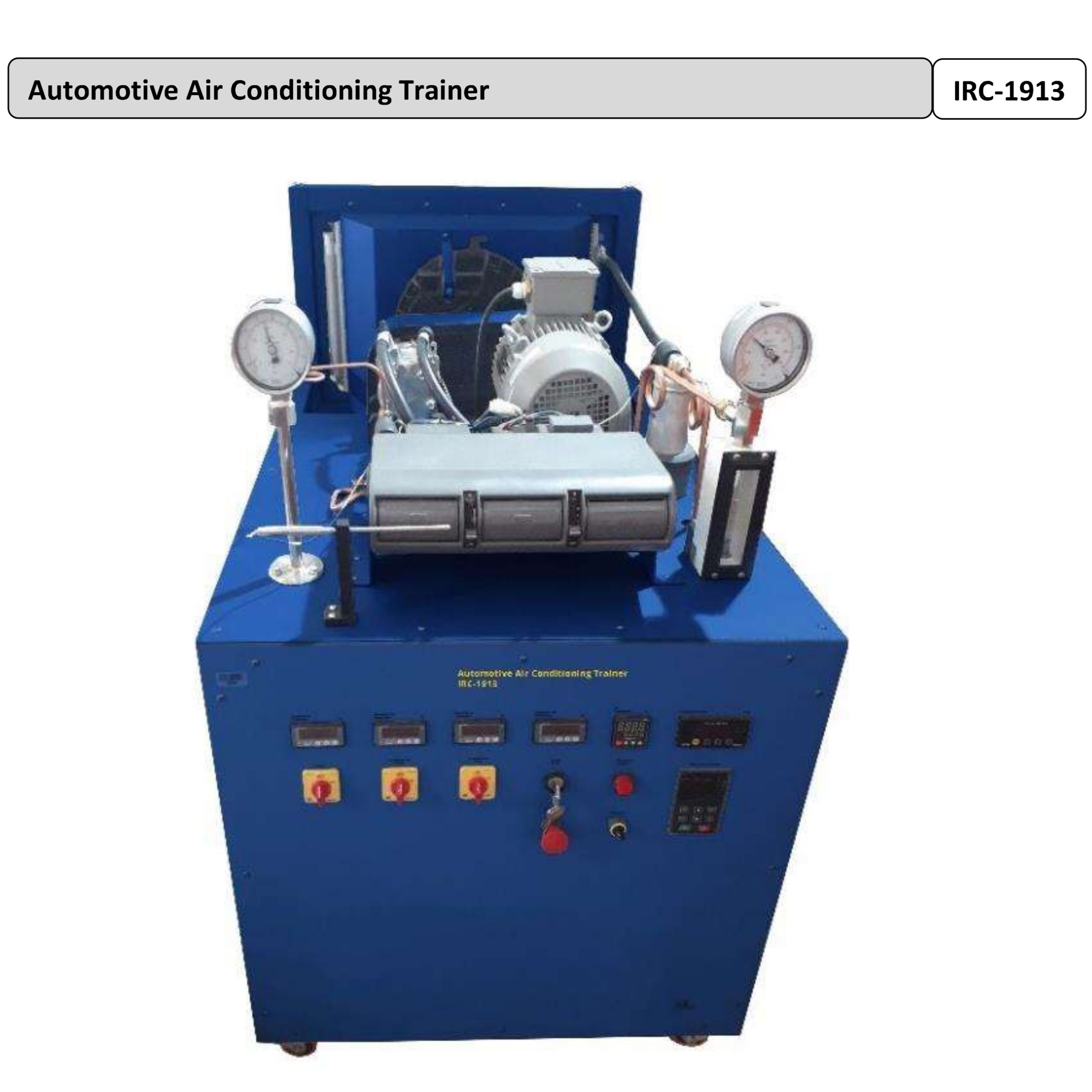
The Automotive Air Conditioning Trainer IRC-1913 is a comprehensive educational and practical training system designed to demonstrate the working principles, operation, and maintenance of automotive air conditioning systems. The trainer closely simulates the actual air conditioning system used in vehicles, making it highly suitable for technical institutes, engineering laboratories, vocational training centers, and automotive training workshops.
The system operates using the recirculating air principle commonly found in modern automobiles. Air from the vehicle cabin is drawn into the system, cooled through the refrigeration cycle, and then circulated back into the cabin area using a fan system. The trainer includes all major components of a real automotive air conditioning unit such as a compressor, condenser with fan, filter/drier, expansion valve, evaporator, and a three-stage air cooler fan. Standard automotive air vents are integrated into the trainer to provide a realistic practical experience.
The compressor is driven by an electric motor through a magnetic coupling and V-belt arrangement, effectively simulating engine-driven compressor operation in actual vehicles. A frequency converter allows variable adjustment of motor and compressor speed, enabling detailed study of system behavior under different operating conditions. The trainer operates using a standard 12VDC automotive power supply and also includes an ignition lock feature similar to real vehicle systems.
The unit allows students and trainees to analyze important operating parameters including refrigerant pressure, temperature, flow rate, compressor power consumption, motor current, and rotational speed. The system uses environmentally friendly R134a refrigerant which is CFC-free.
The trainer is specially developed for educational purposes and provides hands-on learning in automotive refrigeration and air conditioning technology. It supports practical experiments related to refrigeration cycles, system efficiency, coefficient of performance (COP), p-h diagrams, compressor pressure ratio determination, and component functionality. The system can also simulate up to eight common air conditioning faults through an optional fault simulation module, helping students learn troubleshooting and repair techniques in realistic conditions.