Changes of State in Refrigeration Circuit IRC-1904
Technical Information
| Parameter | Description |
|---|---|
| Model | IRC-1904 |
| Compressor | Hermetic motor/compressor unit, piston type |
| Evaporator | Water/R141b evaporator |
| Condenser | Water/R141b condenser |
| Expansion Valve | Manual isenthalpic expansion valve |
| Condenser Flow Meter | Flow meter with control valve of the H₂O delivery at the condenser |
| Evaporator Flow Meter | Flow meter with control valve of the H₂O delivery at the evaporator |
| Pressure Measurement | Pressure gauge for condensation pressure |
| Pressure Measurement | Pressure gauge for evaporation pressure |
| Safety | Maximum pressure safety switch |
| Temperature Indicator | Temperature digital indicator |
| Temperature Sensors | Temperature probes type K type thermocouple |
| Electrical Protection | Magnetothermic differential switch, manual controls and protection fuses |
| Cooling Fluid | R141b |
| Evaporating and Condensing Fluid | Network water |
Experiments Included
- The refrigeration cycle’s theoretical and practical efficiency.
- Studies on the effects of expansion on the refrigeration cycle.
- The construction of a P-h diagram for the refrigeration cycle.
- Study of the compression frigorific cycle.
- Study and visualization of condensation and evaporation.
- Heat balance of the evaporator and the condenser.
Changes of State in Refrigeration Circuit
Model: IRC-1904
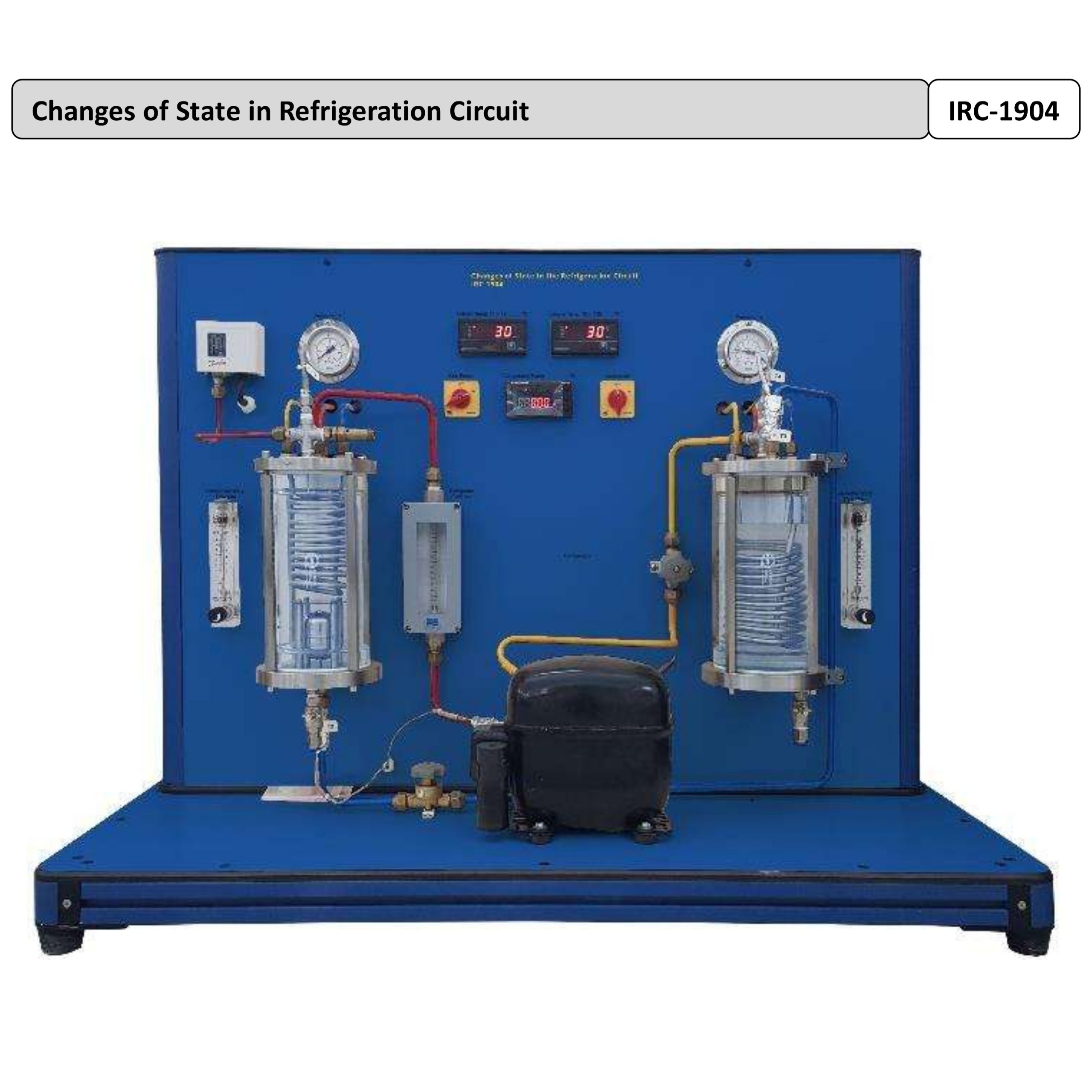
Changes of State in Refrigeration Circuit (IRC-1904) is a demonstrative refrigeration study unit designed to clearly illustrate all the key stages of a compression frigorific cycle, including condensation and evaporation phenomena. The unit features a front panel with a mimic diagram and instrumentation that allows the most important thermodynamic quantities to be monitored, making it easier for teachers and students to understand the refrigeration cycle. The equipment is supplied with manuals covering the components, setup, operating procedures, and experiment activities with outcomes.
A key feature of the apparatus is that it enables students to observe how the cooling fluid affects the glass realized condenser and evaporator. The compression work is performed by a piston-type hermetic compressor. The evaporating and condensing fluid is network water, while the cooling fluid is R141b, selected for its good thermodynamic properties and high safety degree. A manual micrometrical valve provides cooling gas isenthalpic expansion, allowing students to verify the effect of expansion on the thermal balance of the cycle. The integrated instrumentation enables continuous monitoring of the main operating parameters, while the full synoptic panel provides quick comprehension of the frigorific cycle.
Features
- Demonstrates all key stages of a compression frigorific cycle.
- Illustrates condensation and evaporation phenomena.
- Front panel with mimic diagram and instrumentation.
- Continuous monitoring of the main thermodynamic quantities.
- Glass realized condenser and evaporator for visual observation.
- Piston-type hermetic compressor.
- Network water used as evaporating and condensing fluid.
- R141b cooling fluid with good thermodynamic properties and high safety degree.
- Manual micrometrical valve for cooling gas isenthalpic expansion.
- Enables verification of the effect of expansion on the cycle’s thermal balance.
- Two digital instantaneous thermometers with switches for inlet and outlet temperature measurement.
- Two flowmeters for monitoring water flow rates during evaporation and condensation.
- Two pressure gauges for monitoring condensation and evaporation pressures.
- Full synoptic panel for quick understanding of the frigorific cycle.
- Supplied with manuals covering components, setup, operation, and experiment activities.