Electrical Machines System EM6637
Key Features
- Complete training solution for studying modern electrical machines
- Safe operation with fully covered moving parts
- Operates on 24V AC/DC low voltage power supply for enhanced safety
- Compact, low-power, and space-saving design
- Easily stored and packed with dedicated storage trays
- Supports both manual operation and full PC control
- Integrated DC power supply
- Built-in single-phase and three-phase AC variable frequency power supply
- Electronic measurement of:
- Voltage
- Current
- Power (AC & DC)
- Includes 14 embedded instruments within the control box
- Compatible with MATLAB and LabVIEW through API integration
- Real-time RPM and torque monitoring software
- Automatic speed-torque graph generation
- Integrated oscilloscope display and waveform monitoring software
Included Machines & Modules
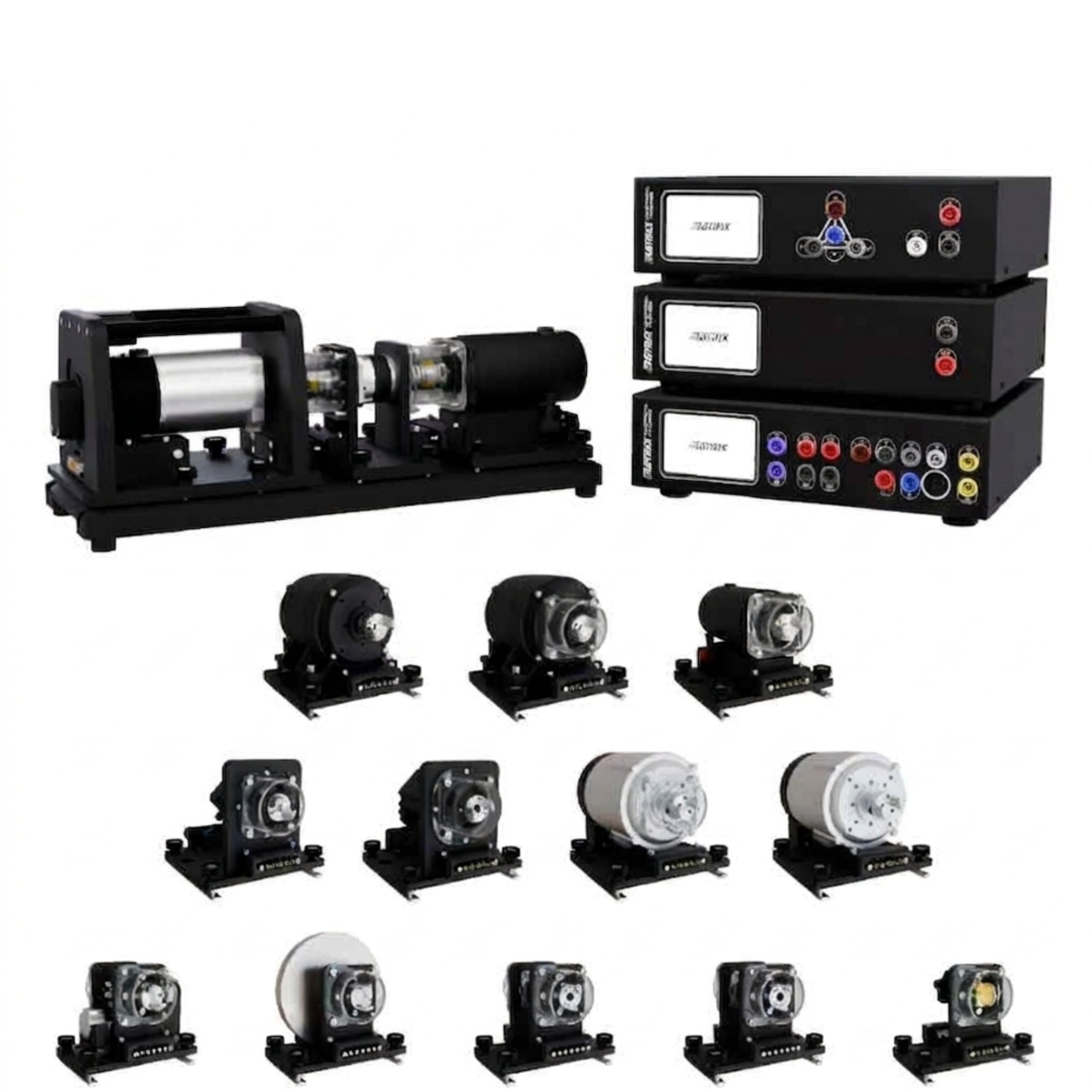
The system includes a comprehensive range of electrical machines for practical experimentation:
- Dynamometer with integrated load cell and rotary encoder
- DC Permanent Magnet Motor / Generator
- DC Shunt Motor
- Separately Excited Motor & Generator
- DC Shunt Generator
- DC Series Motor / Universal Motor
- AC Single Phase Induction Motor
- AC Three Phase Induction Motor
- Star and Delta configurations
- Brushless DC Motor
- Three Phase Permanent Magnet Synchronous Motor & Generator
- Integrated Power Supply & Control Box
- PC-based Advanced Motor Control Applications
Motor Specifications
DC Dynamometer / Motor & Cradle
- Operating Voltage: 24V AC
- Max Current: 2A
- Speed: 1500 RPM
Three Phase Induction Motor
- Operating Voltage: 24V AC
- Frequency: 40–80 Hz
- Max Current: 1.4A
- Speed: 1400 RPM
Brushless DC Motor / 3-Phase Generator
- Operating Voltage: 24V AC
- 3 Phase
- Max Current: 2A
- Speed: 1500 RPM
Single Phase Induction Motor
- Operating Voltage: 24V AC
- Frequency: 40–80 Hz
- Max Current: 1.4A
- Speed: 1400 RPM
Universal / Series Motor
- Operating Voltage: 24V AC
- Frequency: 50 Hz
- Max Current: 6A
- Speed: 1500 RPM
DC Motor
- Operating Voltage: 24V AC
- Frequency: 40–80 Hz
- Speed: 1500 RPM
Shunt Motor
- Operating Voltage: 24V AC
- Max Current: 12A
- Speed: 1500 RPM
Control Box Features
The integrated control box is the heart of the system, enabling manual and PC-based machine control.
Features include:
- Selection of:
- DC output
- Single-phase AC output
- 3-phase AC output
- Integrated voltage and current measurement
- Adjustable resistive loads
- Series winding resistor
- Switchable start and run capacitor
- Compact desktop-sized design
- MATLAB connection API support
Software & PC Control
The Electrical Machines System supports computer-based analysis and advanced experimentation.
Software capabilities:
- Real-time display of:
- RPM
- Torque
- Current
- Voltage
- Speed-torque curve plotting
- Frequency and waveform control
- Digital and pseudo-sine waveform selection
- 3-phase control software with oscilloscope integration
- Performance analysis through voltage/load variation experiments
Learning Objectives / Experiments
Students can study:
- Basic electrical machine operation
- Speed and torque characteristics
- Power and torque relationships
- Slip calculations
- Motor circuit analysis
- AC/DC machine control
- Equivalent circuit development
- Transformer and induction motor analysis
- Electromechanical system characterization
- Comparison of simulated vs real-world values using MATLAB/LabVIEW
Optional Add-ons
Transformer Add-On – EM4425
- Transformer construction study
- Open and short circuit characteristics
- Transformer circuit modelling using MATLAB/LabVIEW
Locked Rotor Add-On – EM2551
- Induction motor open/short circuit analysis
- Advanced induction motor studies
- Circuit modelling using MATLAB/LabVIEW
Electrical Machines System (EM6637)
The Electrical Machines System (EM6637) is an advanced training platform designed for the practical study of modern electrical machines and motor characteristics in a safe and controlled laboratory environment. Developed for technical institutions, universities, and vocational training centers, this system enables learners to explore the operation, performance, control, and analysis of multiple motor types using both manual and PC-based methods.