Features
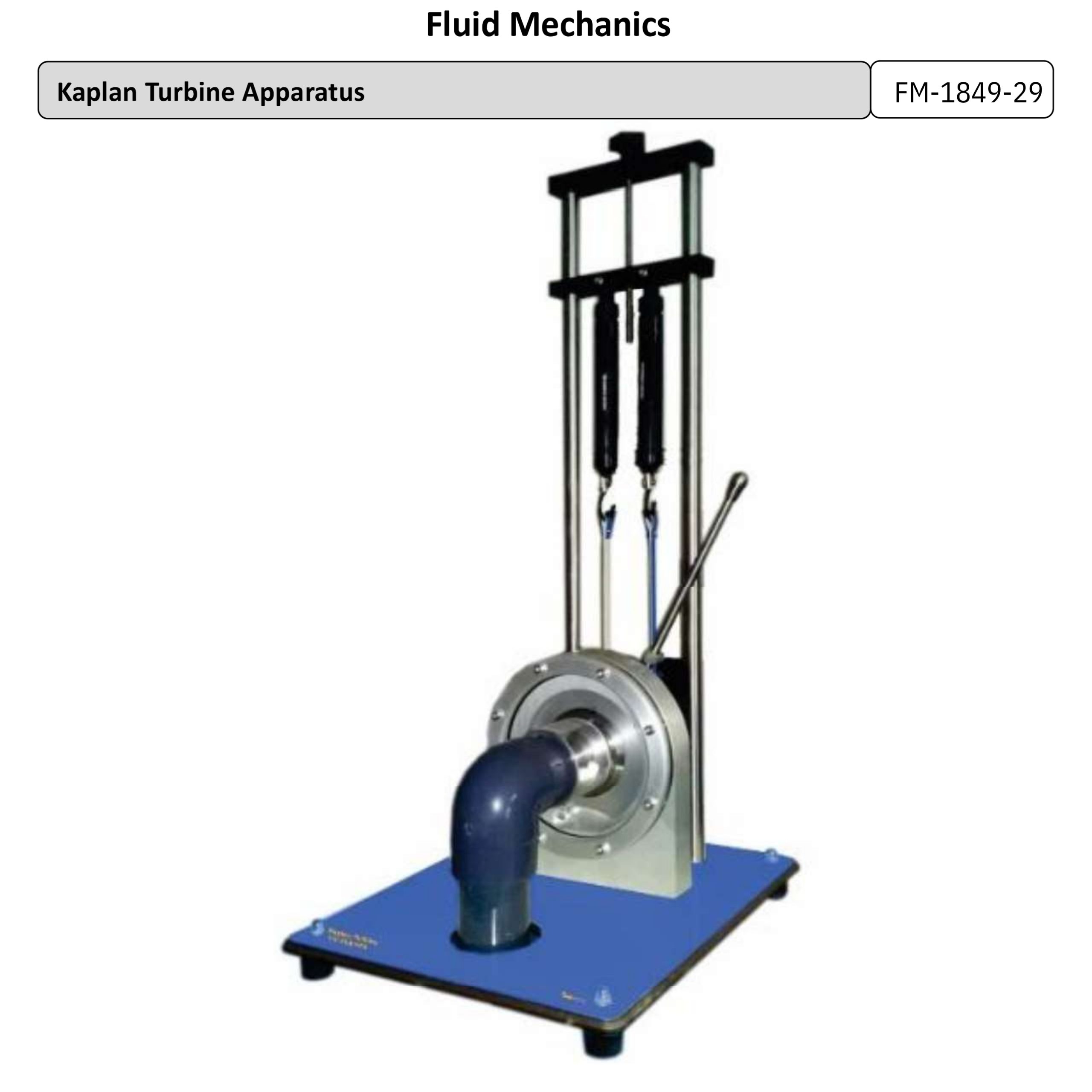
- Transparent turbine casing for clear visualization
- Adjustable guide vanes and runner blades
- Integrated flow measurement system
- Torque and speed measurement for power calculation
- Recirculating water system for continuous operation
- Compact, bench-mounted design
Learning Outcomes
- Understand Kaplan turbine working principles
- Analyze efficiency under different operating conditions
- Study the effect of blade angle and flow rate
- Evaluate hydraulic and mechanical performance
Highlighted Experiments
1. Performance Characteristics of Kaplan Turbine
- Measure flow rate, torque, and rotational speed
- Calculate:
- Output power
- Input hydraulic power
- Efficiency
- Plot efficiency vs. load curve
Objective: Determine optimum operating conditions.
2. Effect of Guide Vane Opening
- Adjust guide vane angles
- Observe changes in:
- Flow rate
- Power output
- Efficiency
Objective: Understand flow control impact on turbine performance.
3. Effect of Runner Blade Angle
- Vary runner blade pitch
- Measure corresponding efficiency and output
Objective: Study how blade geometry affects energy conversion.
4. Torque vs Speed Relationship
- Record torque at different speeds
- Plot characteristic curves
Objective: Analyze mechanical behavior of the turbine.
5. Hydraulic Efficiency Determination
- Compare input hydraulic energy with output mechanical energy
Objective: Evaluate real-world energy losses.