Strain Gauge Trainer SM-1422
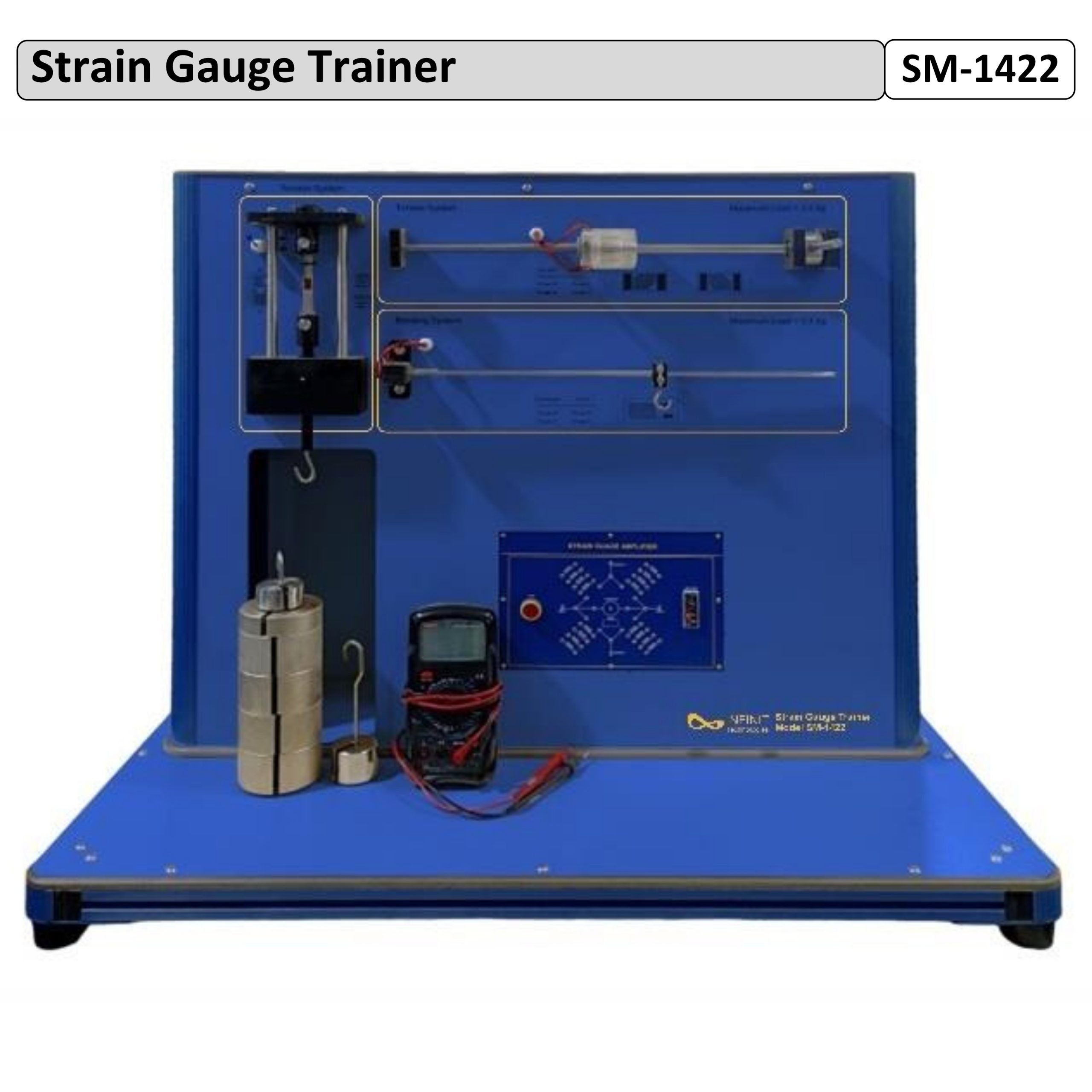
Key Features
Comprehensive Strain Gauge Measurement Training
The trainer provides a complete introduction to strain gauge technology, including:
- Fundamentals of strain measurement
- Principles of electrical resistance strain gauges
- Bridge circuit connections and operation
- Signal conditioning and measurement techniques
- Conversion of electronic output signals into strain and force values
- Experimental analysis of structural deformation
Multiple Mechanical Loading Experiments
The SM-1422 allows investigation of three important mechanical loading conditions:
- Tensile Loading
- Bending Loading
- Torsional Loading
Each experiment helps students understand how materials deform under different stress conditions and how strain gauges accurately measure these deformations.
Multiple Strain Gauge Measurement Locations
Each test specimen includes four strain gauge measurement points, enabling detailed observation of strain distribution across the structure. Students can compare measurements at different locations and gain a deeper understanding of stress and strain behavior.
Complete Bridge Circuit Configuration
The trainer incorporates fully connected strain gauge bridge circuits, allowing users to learn:
- Bridge sensor operation
- Wheatstone bridge principles
- Signal balancing procedures
- Accurate strain measurement techniques
- Load-dependent bridge response analysis
Digital Measurement System
The supplied measuring amplifier provides:
- Digital display of strain-related bridge output
- High measurement accuracy
- Real-time monitoring of strain variations
- Zero balancing (tare) function for preloading compensation
- Stable bridge excitation voltage supply
Protected Experimental Area
A transparent Plexiglas protective cover safeguards the strain gauge measurement area while maintaining full visibility for observation and instructional demonstrations.
Modular and User-Friendly Design
The test specimens can be inserted quickly and accurately into the loading frame, allowing fast experiment setup and repeatable measurements. All components are neatly organized and stored in a dedicated protective box for safe handling and long-term laboratory use.
Educational Objectives
Using the SM-1422 trainer, students can perform experiments and studies on:
Strain Gauge Fundamentals
- Understanding strain gauge construction and operation
- Measurement of mechanical strain
- Practical sensor installation concepts
Strain Gauge Types and Applications
- Different strain gauge configurations
- Industrial applications of strain gauges
- Sensor selection considerations
Mechanical Deformation Analysis
Determination and calculation of deformation under:
- Tensile forces
- Bending loads
- Torsional moments
Poisson’s Ratio Determination
Students can experimentally determine Poisson’s Ratio using tensile testing procedures and strain measurements.
Modulus of Elasticity Measurement
The trainer enables experimental determination of the Modulus of Elasticity (Young’s Modulus) from tensile test data, reinforcing material mechanics concepts.
Correlation Between Electrical and Mechanical Quantities
The system clearly demonstrates:
- Mechanical strain
- Electrical resistance variation
- Sensor output voltage changes
This helps students understand how physical deformation is transformed into measurable electrical signals.
Experimental Capabilities
The trainer supports a wide range of laboratory exercises, including:
- Fundamentals of strain gauge measurements
- Calibration and operation of bridge-type sensors
- Tensile strain measurement
- Bending strain measurement
- Torsional strain measurement
- Force and deformation calculations
- Bridge circuit balancing procedures
- Elasticity modulus determination
- Poisson’s ratio measurement
- Material behavior analysis
- Sensor signal interpretation
- Structural deformation studies
Technical Specifications
Tension Test Specimen
- Measuring Length: 65 mm
- Cross Section: 2 × 12 mm
Bending Test Specimen
- Length: 500 mm
- Cross Section: 5 × 20 mm
Torsion Test Specimen
- Length: 500 mm
- Diameter: 10 mm
Measuring Amplifier
- Measuring Range: ±2 mV/V
- Resolution: 1 µV/V
- Supply Voltage: 10 VDC
- Digital Display
- Zero Balancing (Tare) Function
Loading Weights
- 1 × 1 N Weight Hanger
- 2 × 2 N Weights
- 1 × 1 kg Weight
- 4 × 2 kg Weights
Additional Material Testing Capability
The SM-1422 includes three additional tensile bars manufactured from:
- Brass
- Copper
- Aluminium
These specimens allow students to compare material properties and experimentally determine the modulus of elasticity for different engineering materials.
Scope of Delivery
- 1 × Strain Gauge Trainer Experimental Unit
- 1 × Digital Multimeter (DMM)
- 3 × Sets of Loading Weights
- 1 × Instruction Manual
Strain Gauge Trainer SM-1422
The Strain Gauge Trainer SM-1422 is a comprehensive educational laboratory system designed to provide students and engineers with a practical understanding of strain gauge measurement technology and its applications in strength of materials and structural analysis. This advanced training unit enables users to investigate the relationship between mechanical deformation and electrical resistance while performing real-world experiments involving tension, bending, and torsion loading conditions.
Widely used in engineering laboratories, universities, and technical training institutes, the SM-1422 introduces learners to the fundamental principles of strain measurement and demonstrates how strain gauges are employed in modern sensor systems for measuring forces, moments, stresses, and structural deformations. The trainer bridges the gap between theoretical mechanics and practical measurement techniques by allowing users to observe and analyze strain behavior directly on engineered test specimens.
Why Choose the Strain Gauge Trainer SM-1422?
The Strain Gauge Trainer SM-1422 is an ideal solution for mechanical engineering, civil engineering, mechatronics, and materials science laboratories. By combining practical experimentation with theoretical learning, the trainer provides a complete platform for understanding modern strain measurement techniques, structural analysis, sensor technology, and material characterization. Its robust design, comprehensive experiments, and industry-relevant applications make it an essential educational tool for engineering institutions seeking hands-on training in stress, strain, and structural behavior analysis.